



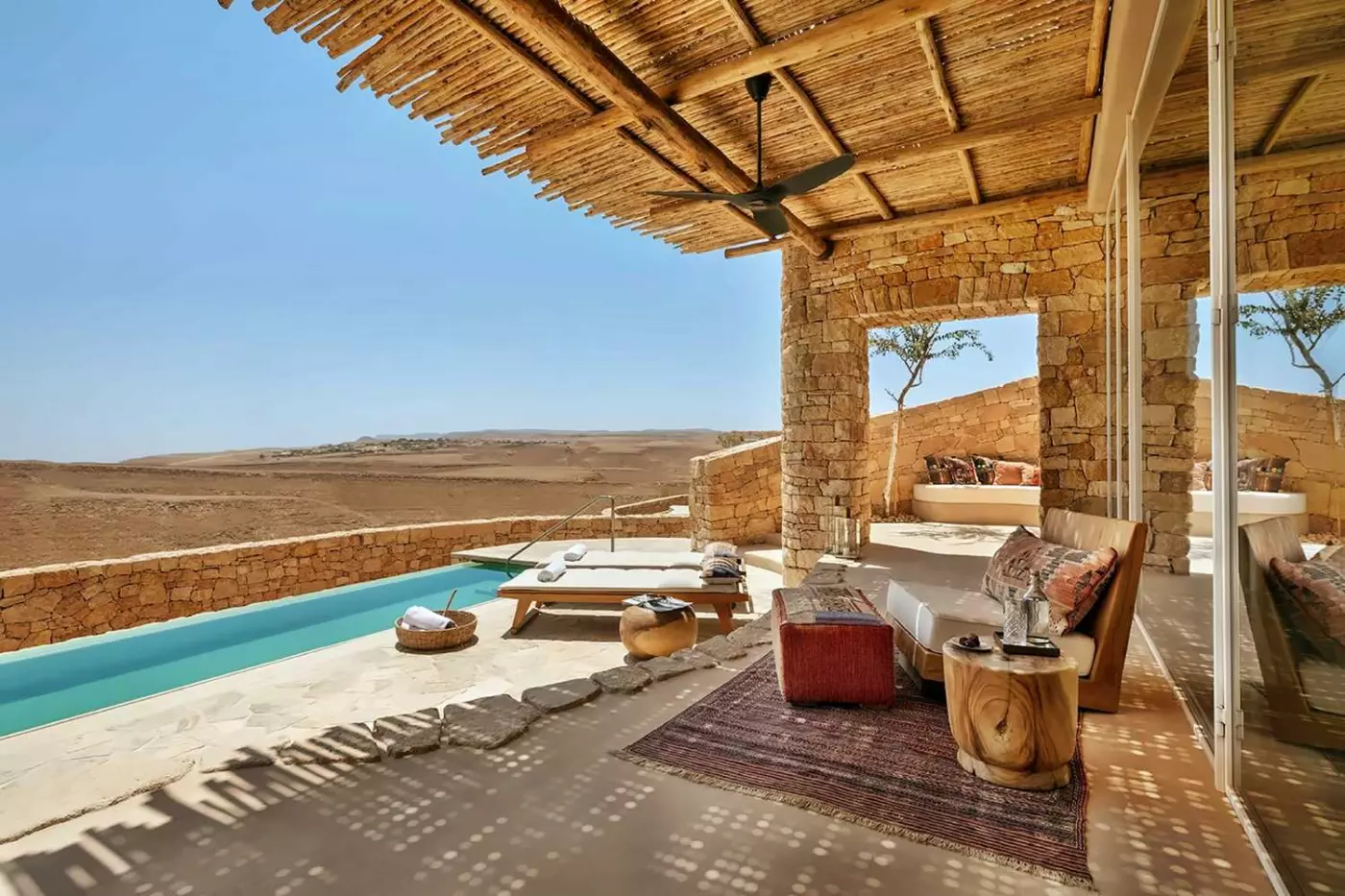
Six Senses Shaharut
Prices From 1’121 USD
+3
More amenities
- Sauna
- Wellness
- Romantic
Six Senses Shaharut is a desert resort in southern Israel, set near the small community of Shaharut in the Negev Desert. The...
Please choose a hotel or destination from the list.
We couldn’t open your search results. Please try again.
Your private search
Finding exceptional stays
The Negev hotel search can include an interest in desert geology and the history of working with copper. Timna provides named subjects for those interests, while Six Senses Shaharut gives the collection an accommodation reference within the desert landscape.
Prices From 1’121 USD
More amenities
Six Senses Shaharut is a desert resort in southern Israel, set near the small community of Shaharut in the Negev Desert. The...
Reserved for You
In the southern Arava, Timna’s Solomon’s Pillars are natural red-sandstone formations shaped by wind erosion through cracks in the rock. The Mushroom has a different form: a large cap above a slender supporting pillar. Erosion gives the two landmarks different shapes within the same desert setting.
During the Egyptian period of activity at Timna, the Mushroom Valley had a copper-smelting site. Ore mined at the foot of the cliffs and acacia fuel were brought there for production. This gives the landscape an industrial and archaeological history alongside its natural forms.
Six Senses Shaharut’s design draws on local rocks and pigments, providing a hotel example of a material relationship with the desert. Our Israel destination guide supplies the wider country context.
Shaharut is a small settlement in Hevel Eilot, in the southern Negev’s Arava region. Six Senses Shaharut occupies a desert cliff setting. This is a rural desert base, rather than a large city hotel district.
It identifies the valley landscape associated with the resort’s elevated setting. That gives the accommodation a more precise geographic context within the Negev. Use it to understand the surroundings rather than treating every desert outlook as the same experience.
It concerns the hotel’s approach to resources, local production and environmental learning. Consider it as a possible topic of interest rather than as a guarantee of a particular programme. Its value is in understanding the relationship between hospitality and the desert setting.
Hai-Bar Yotvata focuses on restoring wildlife that disappeared from Israel, particularly the Asian wild ass and Arabian oryx. Its role goes beyond keeping desert animals on display: a breeding core at Yotvata supported the oryx’s reintroduction into Negev landscapes.
Lotan’s EcoCampus uses straw bales and earth plaster around geodesic frames. The bales provide insulation, while the heavier plastered walls and floors store heat. Southern windows admit winter sunlight; selective window placement supports ventilation in hot periods.