



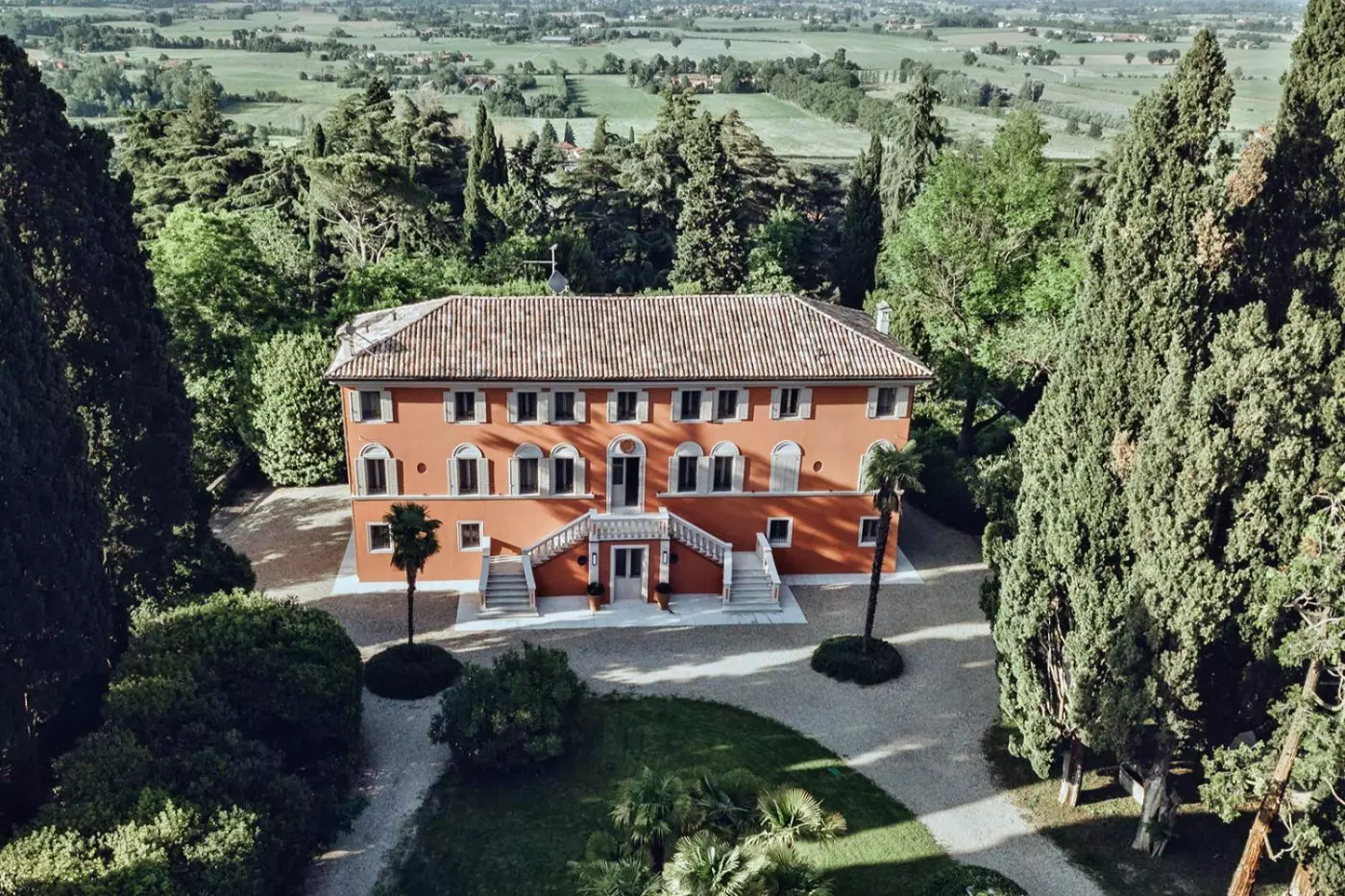
Relais Roncolo 1888
Prices From 740 USD
Relais Roncolo 1888 is a small country hotel on Tenuta di Roncolo, an organic estate in the hills of Quattro Castella in Emil...
Please choose a hotel or destination from the list.
We couldn’t open your search results. Please try again.
Your private search
Finding exceptional stays
Quattro Castella gives an Emilia country stay a local architectural history beyond its castle image. Parish churches record successive building campaigns and the people who paid for them. Alongside a hotel choice such as Relais Roncolo 1888, those buildings offer a particular way to understand the surrounding settlements.
Prices From 740 USD
Relais Roncolo 1888 is a small country hotel on Tenuta di Roncolo, an organic estate in the hills of Quattro Castella in Emil...
The parish church of Sant'Antonino stands on the site and remains of an older church from the Matildic period. Squared sandstone blocks and carved fragments preserve evidence of that earlier building. They give the structure a history that extends beyond its later appearance.
The church was rebuilt gradually. Work in the early eighteenth century under Alfonso Canossa lengthened the nave and added the altars of Saint Peter and Saint Louis. For a traveller interested in architecture, that sequence offers a way to consider how a building changes as priorities and resources allow.
Holes in Sant'Antonino's facade and sides record where scaffolding beams were inserted during construction. These small physical traces give a different subject from the larger architectural form. A wall can preserve the process of making a building as well as the finish its builders intended.
Consider that distinction when looking at historical structures. A decorative fragment and a construction mark carry different kinds of evidence. The appeal lies in understanding the particular detail, rather than reducing an old church to a general period label.
San Giorgio in Roncolo introduces another local building history. Its earlier chapel appears in a donation document from 1082, while the old church remained in use until the eighteenth century. In 1732, Canon Prospero Scaruffi paid for a new church to be built from the foundations.
This relationship between an inherited place of worship and an individual's patronage gives Roncolo a subject of its own. Our Italy destination guide places the country stay within a wider journey, with these local buildings adding architectural detail to the Emilia chapter.
No. The destination’s name refers to four castle hills, while Bianello is the one preserved intact. Keep that distinction clear when planning a historical outing. The landscape’s significance does not depend on every hill offering the same kind of building visit.
Roncolo belongs within the municipality of Quattro Castella. The estate provides a specific countryside setting, rather than an unrelated urban stop. Understanding that scale helps when deciding how the hotel relates to the wider destination and nearby regional interests.
Erbazzone is a savoury baked pie with a spinach-and-chard filling between two thin sheets of unleavened pastry. Parmigiano Reggiano, breadcrumbs, onion and pork fat contribute to the filling; the pastry also uses lard. Its green appearance therefore does not imply a meat-free recipe. It belongs to the food culture of Reggio Emilia province, including Quattro Castella.
The oasis lies within Quattro Castella near Monticelli, combining woodland, small meadows, scrub and cultivated ground. Oaks grow with hornbeams, manna ash and maples above an understorey of dogwood, privet and hazel.
Spergola offers a white-wine subject from the Reggio Emilia hills. The grape produces pale straw-coloured wine with floral and green-apple notes and a fresh acidic edge. It is used for dry, semi-dry and sweet styles, and as a sparkling-wine base.