



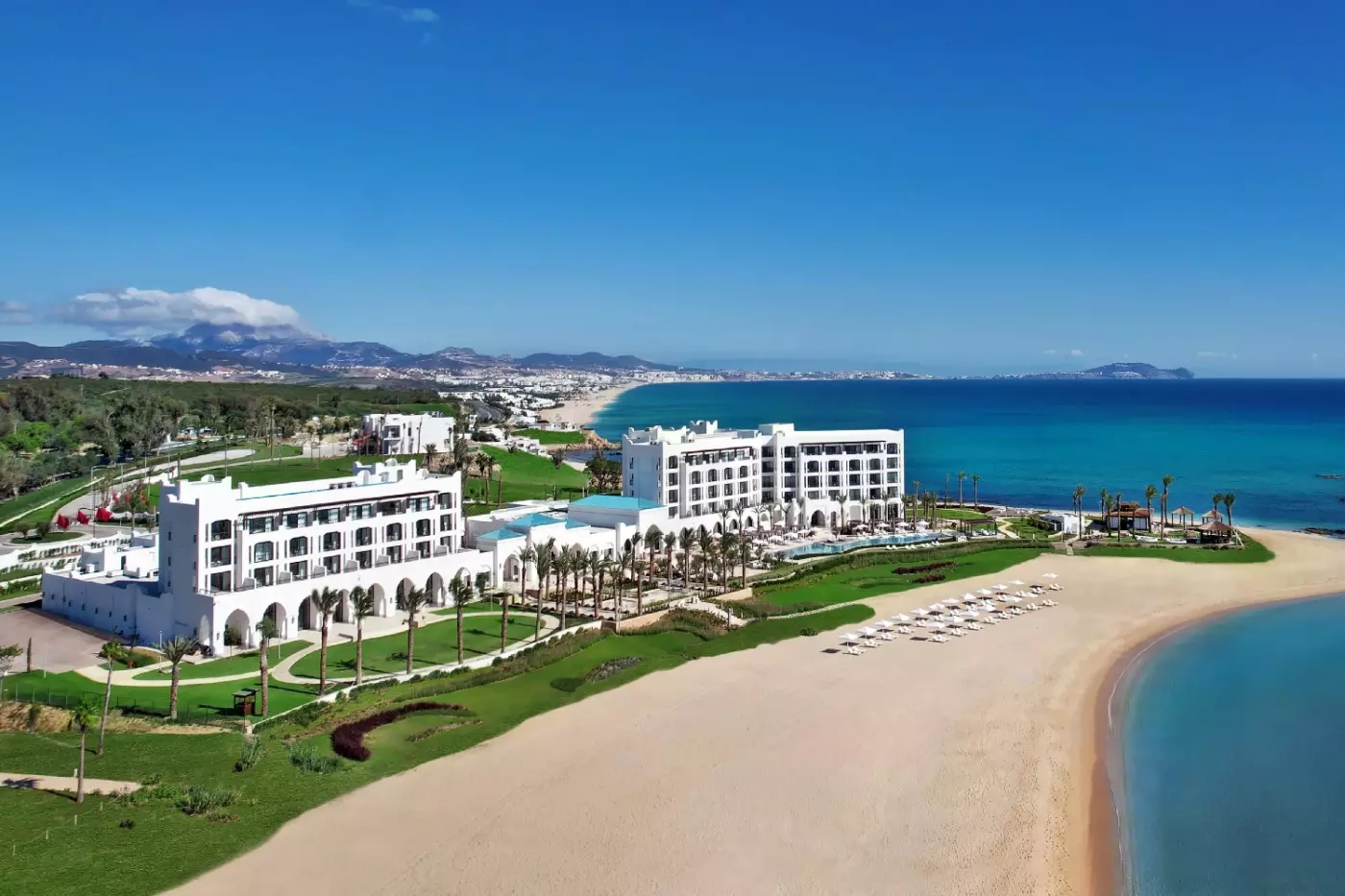
St Regis La Bahia Blanca Resort
Prices From 312 USD
+3
More amenities
- Sauna
- Beach
- Romantic
At The St. Regis La Bahia Blanca Resort, Tamuda Bay, the Mediterranean is visible from the guest rooms. Private balconies and...
Please choose a hotel or destination from the list.
We couldn’t open your search results. Please try again.
Your private search
Finding exceptional stays
The St. Regis La Bahia Blanca Resort provides the Tamuda Bay accommodation reference. Alongside a stay chosen for its immediate setting, an interest in northern Morocco's archaeology can give a cultural visit a specific focus.
Prices From 312 USD
More amenities
At The St. Regis La Bahia Blanca Resort, Tamuda Bay, the Mediterranean is visible from the guest rooms. Private balconies and...
The St. Regis La Bahia Blanca Resort occupies a beachfront setting in Tamuda Bay, on Morocco’s northern Mediterranean coast.
The Archaeological Museum of Tétouan brings together prehistoric, ancient and Islamic objects from northern Morocco. Finds come from sites including Lixus, Tamuda and Ksar Es Sghir. Stone tools, ceramics, coins and bronze statuettes give the collection subjects beyond the appearance of a historic building.
For someone interested in material culture, these different objects offer ways to think about daily life and the evidence that survives it. Choose an area of curiosity to follow: an interest in making a vessel is different from looking at a coin as a historical document. That focus can give a museum visit more meaning than trying to remember every label.
The museum's entrance vestibule contains Roman mosaics from Lixus depicting the Three Graces and the procession of Bacchus as a child. The figures give an art-focused visit a particular subject to examine. Look at how a scene is arranged and how the figures relate to one another, allowing attention to the image itself.
This approach suits travelers who enjoy looking closely at a small number of works. Companions with a broader interest can consider the range of objects, while someone drawn to figurative art may want longer with the mosaics.
Our Morocco destination guide supplies the wider country context.
No. It is a Mediterranean setting in northern Morocco. Keep the exact coast clear when shaping the journey, rather than treating every Moroccan beach destination as interchangeable. Choose the actual landscape you want around the accommodation.
No. It is a separate urban historical setting. Choose a focused cultural outing if it interests you, while keeping the hotel’s coastal role distinct. That clarity helps give both parts of the visit enough attention.
It provides a useful cultural lens for exploring Tétouan’s medina. Approach the setting with that historical interest rather than seeing only an attractive old town. A clear subject can make the visit more rewarding than an unfocused circuit.
Dar Sanâa, opposite Bab El Oqla, is Tétouan’s National School of Arts and Crafts. Its Andalusian-style building houses objects illustrating traditional craftsmanship as well as a heritage interpretation centre. Wood carving, painted wood, leatherwork, embroidery and zellige tilework belong to the school’s craft traditions.
The Centre d’Art Moderne de Tétouan occupies the city’s former railway station, designed by the Spanish architect Julio Rodrigues Roda and inaugurated in 1918. Its subject is the local school of painting, tracing pioneers of the early twentieth century through later modern and contemporary expression.