



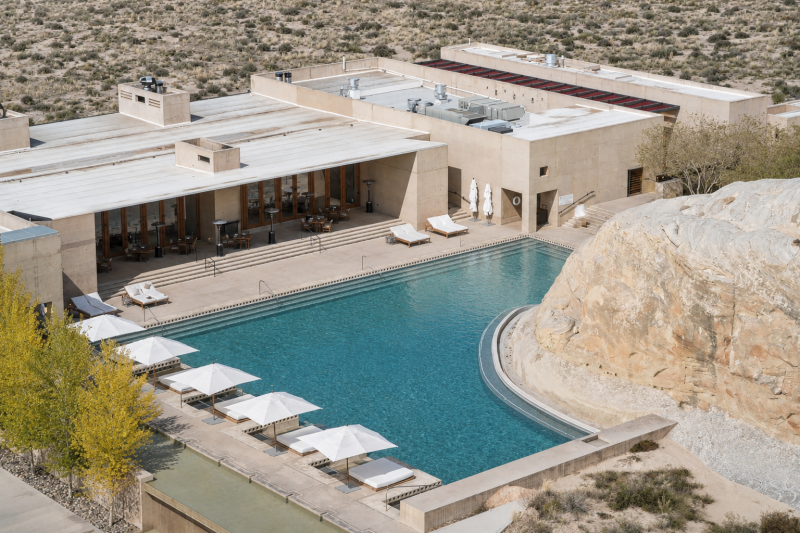
Amangiri
Prices From 5’159 USD
+4
More amenities
- Sauna
- Culture
- Romantic
- Adventure
Amangiri is a desert resort in Canyon Point, southern Utah, near Lake Powell and the Arizona border. Its 34 suites face the s...
Please choose a hotel or destination from the list.
We couldn’t open your search results. Please try again.
Your private search
Finding exceptional stays
Canyon Point offers a southern Utah stay shaped by sandstone, open space and the changing appearance of the desert landscape. Choose a luxury retreat for the relationship you want with that setting.
Prices From 5’159 USD
More amenities
Amangiri is a desert resort in Canyon Point, southern Utah, near Lake Powell and the Arizona border. Its 34 suites face the s...
Reserved for You
Amangiri is the Canyon Point base at 1 Kayenta Road in southern Utah. Mesas and canyon landscapes surround this desert stay. Camp Sarika is its related accommodation setting within the same wider landscape.
The accommodation is the base for the sandstone country, not an urban hotel district. A visit can remain local to the retreat landscape or include a regional geological stop. The surrounding desert is the central reason for this part of a Utah journey.
The wider Glen Canyon region exposes layers of sandstone. Navajo Sandstone records ancient dune fields; its rock now forms cliffs and slickrock canyons. Wingate Sandstone contributes sheer red cliffs, while the Kayenta Formation has ledges and slopes of interbedded shale and sandstone.
The Colorado River and its tributaries cut into these layers after the Colorado Plateau rose. Their erosion exposed older rock beneath newer deposits. A regional canyon visit therefore brings together an ancient dune landscape and the later river-cutting history that formed the canyons.
Big Water Visitor Center lies along Highway 89 between Kanab and Page. Its paleontology and geology exhibits include locally discovered dinosaur material and a mural reconstructing the Late Cretaceous landscape. It provides an indoor regional stop for the prehistoric life behind the rocks, alongside outdoor time around Canyon Point.
The Utah hotel guide places this southern desert base alongside other parts of the state.
Springs can feed hanging gardens where water passes through porous rock and meets a less permeable layer. It then seeps from the canyon wall, supporting plants at the cliff face. These small wet habitats add a botanical interest to the regional desert landscape; they are not a description of hotel gardens.
No. The main resort and the tented-pavilion camp offer distinct approaches within the desert setting. Choose the accommodation character you want rather than treating the shared regional context as proof of an identical stay.
No. Geological scenery and quieter observation can be meaningful interests on their own. Choose any demanding activity for its suitability to you, rather than assuming it is required to appreciate the landscape.
It offers a water-based contrast to the mesas and canyons. Treat it as a separate interest within the regional plan, rather than another stop to add merely because it is well known.
Successive cliff bands rise northwards from the Grand Canyon towards Utah’s high plateaus, with terraces between them. The sequence includes the Vermilion, White, Gray and Pink cliffs. The name describes this stepped regional landform, giving a wider geographical context to a southern Utah desert stay.