



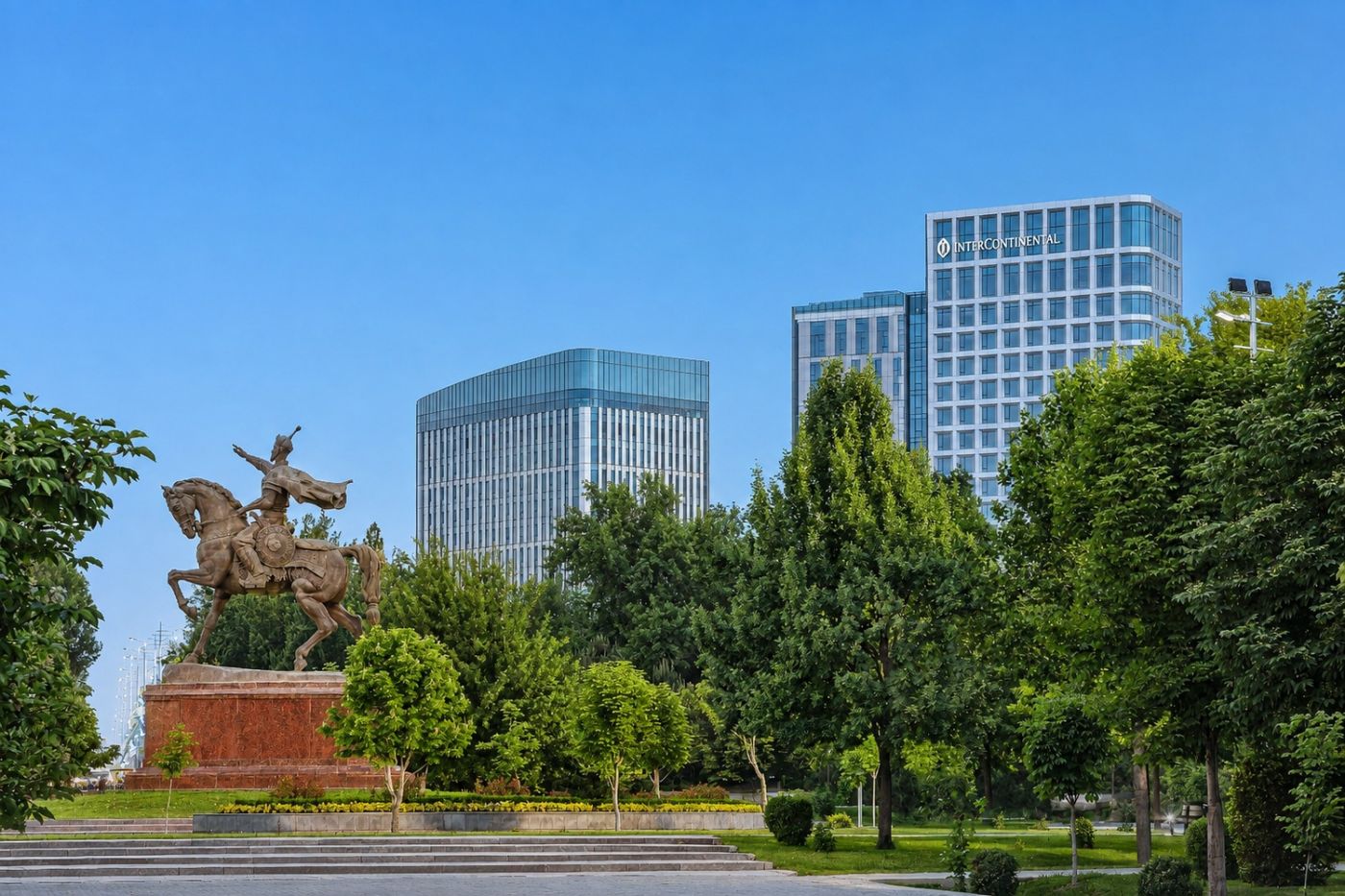
InterContinental Tashkent
Prices From 289 USD
+3
More amenities
- Sauna
- Culture
- City Vibe
InterContinental Tashkent is a strong choice when a stay in Uzbekistan's capital needs polish, space, and simple daily logist...
Please choose a hotel or destination from the list.
We couldn’t open your search results. Please try again.
Your private search
Finding exceptional stays
InterContinental Tashkent gives an Uzbekistan journey a capital-city base on Shakhrisabz Street. Beyond Tashkent’s markets, collections and metro, Samarkand, Bukhara and Khiva offer distinct architectural chapters. Choose them for the differences between monumental squares, religious ensembles and a walled inner town, with the capital hotel as a separate part of the route.
Prices From 289 USD
More amenities
InterContinental Tashkent is a strong choice when a stay in Uzbekistan's capital needs polish, space, and simple daily logist...
InterContinental Tashkent is at 2 Shakhrisabz Street. Chorsu bazaar brings food and commerce into the capital visit, while craft collections and the metro add decorative arts and modern city life. These are Tashkent outings from the city base, alongside the separate historic-city stays elsewhere in the country.
Our Tashkent destination guide develops the capital’s local accommodation choice.
In Samarkand, Registan Square is defined by the Ulugbek, Sherdor and Tilla-Kari madrasas. The three buildings frame a monumental public square. Shahi-Zinda is a necropolis, shifting the focus toward tomb architecture and memorial buildings. A Samarkand visit can take in both the grand square and the more concentrated tomb architecture.
Bukhara brings the Kalon minaret, Kalon mosque and Miri-Arab madrasah together at Poi-Kalyan. Lyabi Hauz offers another ensemble around a pond, with madrasas and a khanaka adding to its setting. The minaret ensemble and the pond provide two distinct stops within Bukhara’s historic centre.
In Khiva, Itchan Kala is the inner town enclosed by brick fortification walls. Mosques, madrasas, palaces and dwellings sit within this defined urban area. Here, the visit follows a historic quarter containing both everyday dwellings and major monuments. The walls bring those buildings into one defined townscape, unlike a visit focused on a single square.
Include it when its capital life, museums and craft interests add useful contrast. It does not need to imitate the monumental cities to justify time. Choose the role deliberately rather than assuming it is only an unavoidable transit night.
Rishtan, between Fergana and Kokand, is known for its ceramics. The pottery traditions include distinctive colors, patterns and shapes, with local masters passing on their skills. Choose it for an applied-art chapter in the Fergana Valley, beyond looking at architectural tilework on historic monuments.
In northwestern Uzbekistan, Nukus is the capital of Karakalpakstan and home to the Savitsky Museum. Its Russian avant-garde collection gives an art journey a different focus from monumental Islamic architecture. Consider the city as a distinct regional chapter when that collection is a principal interest.
Margilan in the Fergana region is a center for silk fabrics and ikat traditions. Yodgorlik is associated with producing khan-atlas silk and adras mixed-silk fabrics. A textile-led visit gives attention to thread, color and making, rather than treating every craft encounter as a general souvenir stop.
No. Museums and an interest in materials can provide cultural understanding without purchases. Choose the encounters that interest you and keep learning distinct from shopping. That perspective can enrich several parts of the journey without dominating it.