



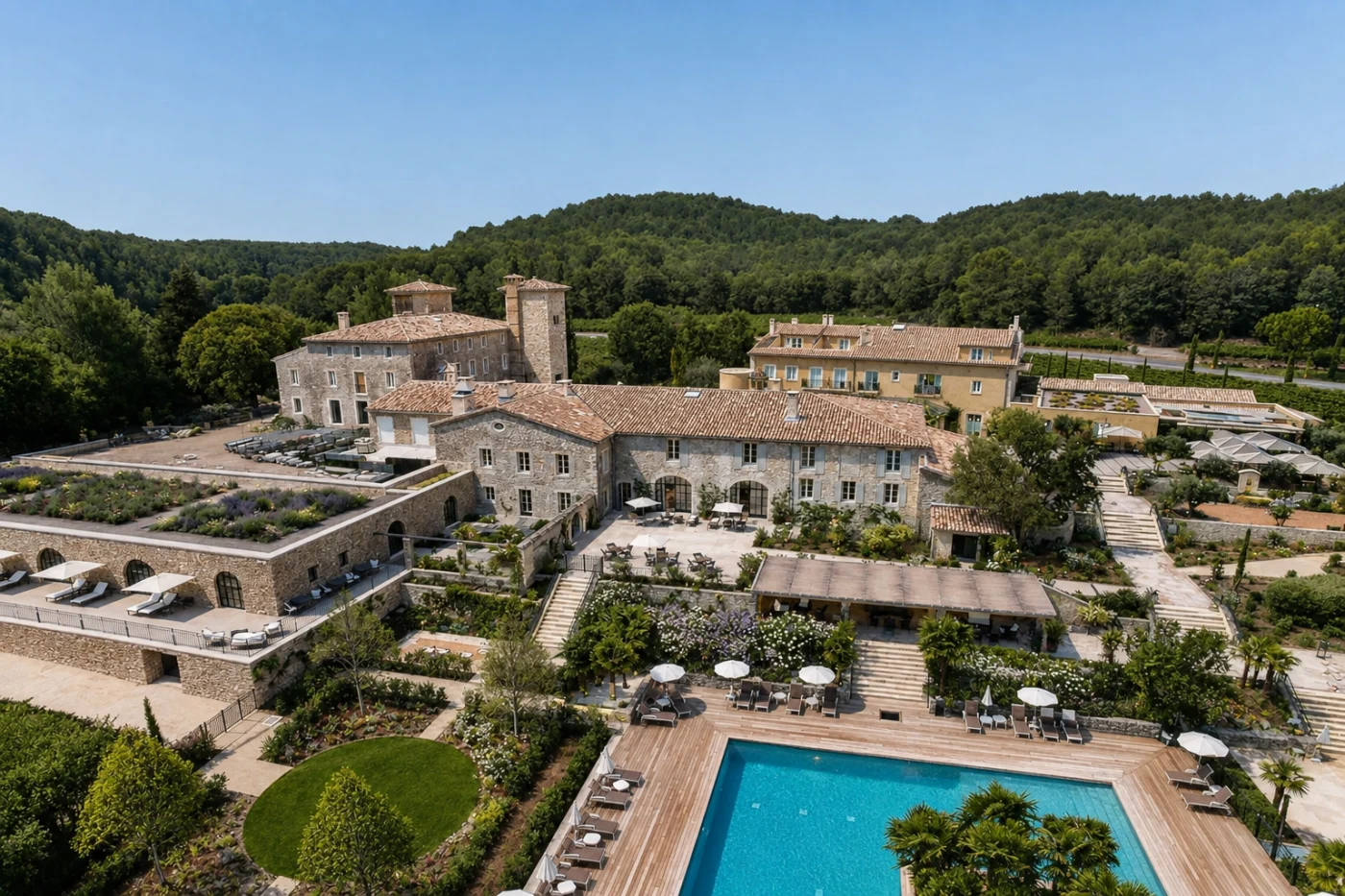
Chateau de Berne
Prices From 463 USD
+3
More amenities
- Sauna
- Wellness
- Romantic
A small road through woodland and olive groves leads to Chateau de Berne, a five-star Relais & Chateaux hotel on a working wi...
Please choose a hotel or destination from the list.
We couldn’t open your search results. Please try again.
Your private search
Finding exceptional stays
Lorgues offers an inland Provençal stay among vineyards, with Château de Berne as the estate base. Beyond the vines, the town’s church and Draguignan’s collections introduce different parts of the region’s history: religious art, agriculture and the working lives behind the landscape.
Prices From 463 USD
More amenities
A small road through woodland and olive groves leads to Chateau de Berne, a five-star Relais & Chateaux hotel on a working wi...
Vineyards give this part of Provence a particular identity. Château de Berne combines that landscape with a country-hotel setting, making the estate itself a reason to stay. Choose time to look around, enjoy a considered meal and understand how cultivation shapes the land, rather than using the vineyards only as a background to a photograph.
The Collégiale Saint-Martin gives a Lorgues outing an architectural and artistic focus. Built between 1704 and 1729, it contrasts a relatively restrained classical interior with the polychrome marble of its Baroque high altar. The main nave’s cruciform pillars and paired arches frame the side chapels.
Some works also connect Lorgues with other Provençal places. A Virgin by Pierre Puget, dated 1694, came from the Abbey of Le Thoronet, while the high altar was acquired from the Observantine fathers in Marseille. For a visitor interested in sculpture and church interiors, these objects bring a regional story into one building.
Draguignan’s Musée des Arts et Traditions Populaires approaches the region through everyday life in the nineteenth and twentieth centuries. Its ethnographic collections grew through donations from people who lived and worked locally. Agriculture, industry, religion and celebrations all have a place in that history.
The agricultural machinery gallery gives cultivation a material form, complementing time spent among the estate’s vines.
This is a choice for vineyards and the interior of the Var, not an oceanfront base. If a coastal chapter belongs in the wider journey, give it its own reason and setting rather than expecting one address to deliver every version of southern France.
Our France guide places this vineyard and village landscape within the wider national journey.
No. Château de Berne produces Côtes de Provence wines in rosé, white and red styles. That gives a wine interest more range, allowing you to look at different expressions of the area rather than treating every tasting as the same subject.
Its elevated setting gives a visit a panoramic subject, reflected in its familiar description as a village in the Provençal sky. Choose it for that landscape relationship rather than expecting another version of time on a wine estate.
Its fountains, bridges and Romanesque chapel interests give a village visit an architectural thread. Choose one of those subjects for closer attention, rather than making Salernes merely another place name in a sequence of brief stops.
Its caves and troglodyte dwellings add a different built-landscape subject. Choose it if the relationship between settlement and rock interests you, keeping that visit distinct from a vineyard outing or an estate afternoon.
No. It lies in a rural estate setting between Lorgues and Flayosc. Use that actual position to understand the stay. The destination label should not create an expectation of stepping straight from the hotel into central Lorgues streets.