Best for
If your Marrakech plans mix Medina exploration with quiet garden time, La Mamounia puts both within reach.
Please choose a hotel or destination from the list.
We couldn’t open your search results. Please try again.
Your private search
Finding exceptional stays
Best for
If your Marrakech plans mix Medina exploration with quiet garden time, La Mamounia puts both within reach.
What makes it special
Its private riads have separate entrances, pools, and terraces, giving guests more seclusion while keeping the palace's wider facilities nearby.
Room to consider
When choosing a room, compare garden, pool, Koutoubia, and Hivernage views; some also have balconies for time outdoors.
Insider tip
Walk the garden paths in the morning to see the olive and citrus trees before heading out into Marrakech.
Free membership gives you access to preferred rates, exclusive benefits and current promotions for your stay.
La Mamounia is not the most private hotel in Marrakech, and it is not trying to be. Its power comes from a different place: scale, history, gardens, public rooms, restaurants, spa life, and a location beside the medina walls. Guests choose it when they want the city's grand hotel, not a hidden riad or a villa resort on the edge of town. It has 135 rooms, 71 suites, and 3 private riads, so the stay feels social, theatrical, and deeply tied to Marrakech's image of itself.
 209
 Trendy
 Fitness
 Pool
 Spa
 Wellness
 City Vibe
 Pet Friendly
 Wheelchair Accessible
 Connecting Rooms
Neutral walls and pale carpet set off the carved timber and deep red fabrics in these lower-floor rooms. Some designs place a broad wooden headboard behind both beds. Another has soft padded panels and an ornate mirror, with a writing desk and cushioned chair by the window.
Patterned wall borders and hanging lanterns bring Moroccan detail to the calm colour scheme. Carved doorways add texture between the spaces. Rooms are on the garden level or first floor, on the main entrance side. Wood and tadelakt meet rich fabrics throughout the decor. The marble bathroom contrasts pale stone with dark joinery, with separate spaces for baths and showers.

Neutral walls and pale carpet set off the carved timber and deep red fabrics in these lower-floor rooms. Some designs place a broad wooden headboard...
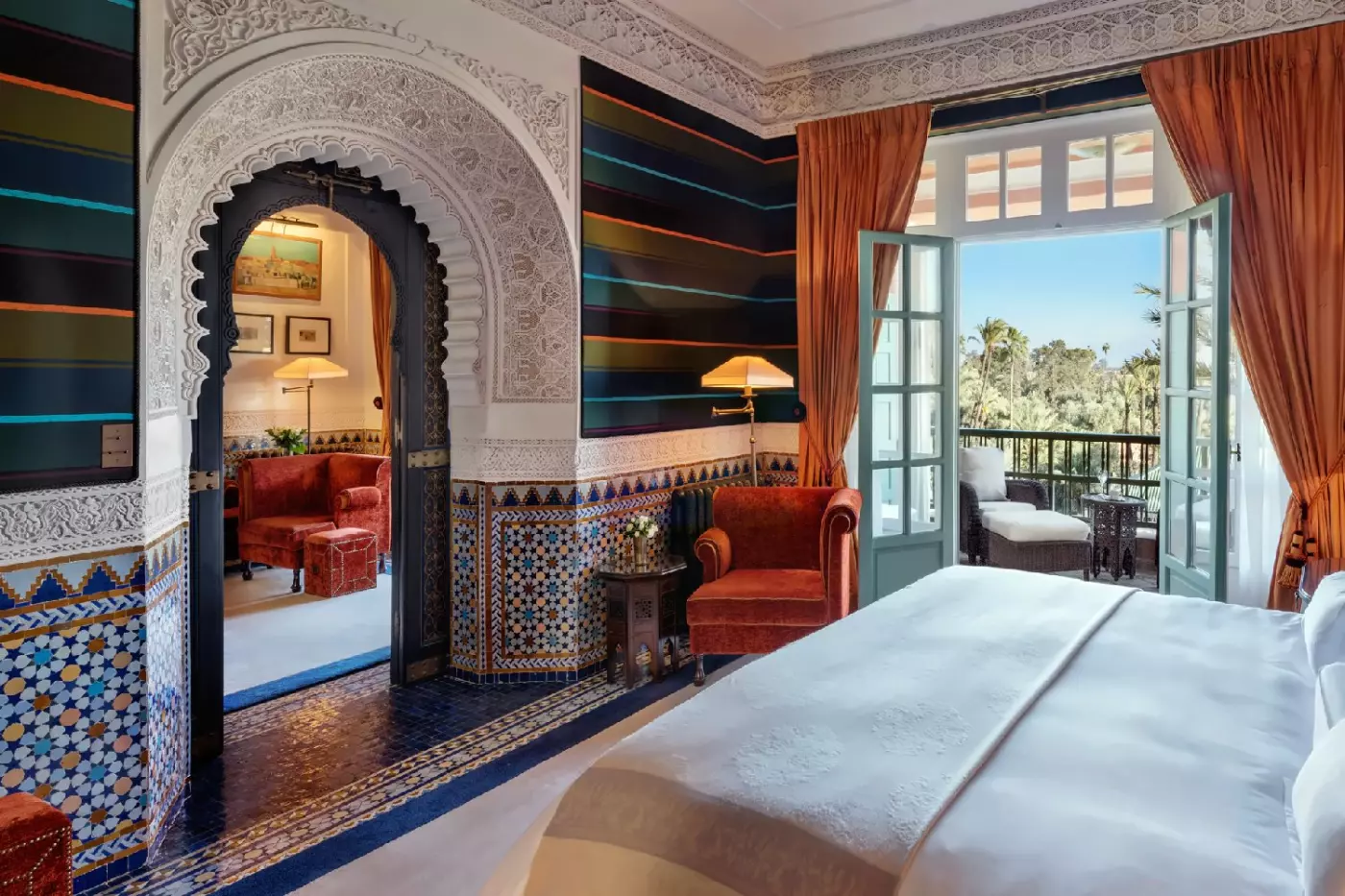
Colourful zellige tiles form a band around the room, below pale walls and a finely carved plaster border. The rounded headboard echoes the arched motifs. Striped curtains frame the windows, with green chairs and a writing desk set away from the bed.
These rooms are on the second to fourth floors. Framed photos and green-based lamps add detail near the bed, with pale carpet underfoot. An arched passage leads to the bathroom, where strongly veined marble meets warm-toned walls. A dark-framed mirror hangs above the basin counter, and glass panels enclose the shower. Traditional patterns continue around the niches and doors.

Colourful zellige tiles form a band around the room, below pale walls and a finely carved plaster border. The rounded headboard echoes the arched motifs....
Only some rooms have a balcony or terrace.
Light fabrics and cream walls surround the rounded, carved headboard. A patterned foot bench echoes its scalloped shape, and small coloured tiles line the lower walls. Dark wooden doors and an ornate arch mark the bathroom entrance. Framed photos hang beside the bed.
Green-based lamps and a padded chair add colour among the darker furniture. Some rooms face the mosque itself; others look towards the gardens on the Koutoubia side. The marble bathroom pairs pale stone with traditional Moroccan details and warm light.

Light fabrics and cream walls surround the rounded, carved headboard. A patterned foot bench echoes its scalloped shape, and small coloured tiles line the lower...
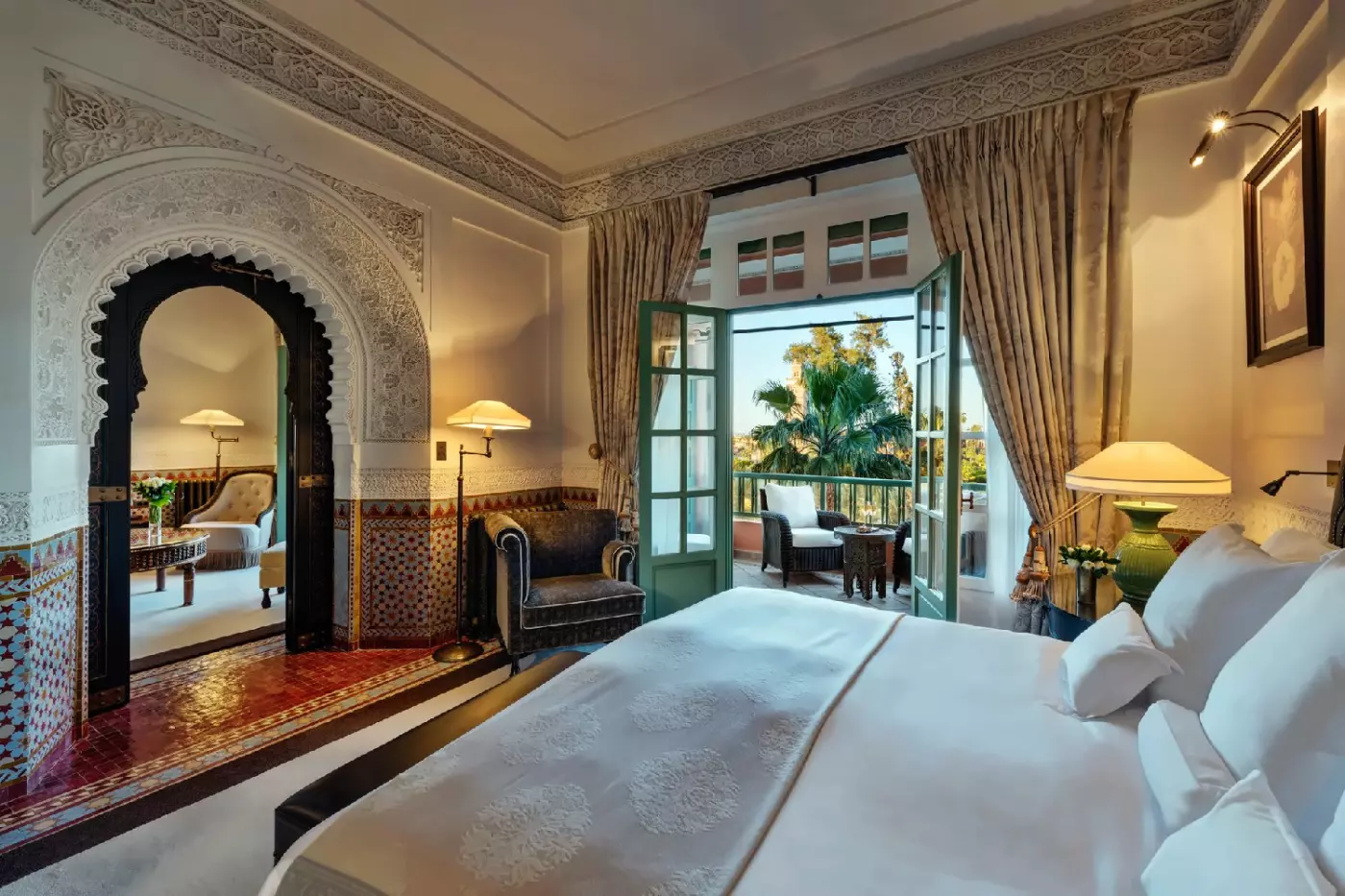
Turquoise doors lead to an outdoor sitting area with woven chairs and a small round table. Pale carpet and walls keep the bedroom light, with a green chair beside the window. The scalloped headboard and matching foot bench pick up the patterns in the tiles.
In the twin-bed design, each headboard has its own shape. A writing desk and chair sit near the windows, framed by patterned curtains. Photos and finely carved ceiling borders add Moroccan detail to the sleeping space. Rooms occupy different floors of the hotel. Soft light falls on the bathroom’s marble surfaces, with dark wooden doorframes contrasting against the pale interior.

Turquoise doors lead to an outdoor sitting area with woven chairs and a small round table. Pale carpet and walls keep the bedroom light, with...
Ochre details warm the pale walls and carpet around the rounded, carved headboard. Dark furniture and a green chair sit beside the writing desk. Framed photos hang below a carved plaster border, and striped curtains surround the tall French doors.
The historic Agdal quarter and distant Atlas Mountains form part of the wider outlook. A connecting door joins each outdoor terrace to its neighbour. Strongly veined marble covers the bathroom’s lower walls below gold-toned plaster. A broad, decorated mirror hangs above the white basin, with an arch around the shower fittings. Carved shapes and tiled borders continue the bedroom’s craft into this space.

Ochre details warm the pale walls and carpet around the rounded, carved headboard. Dark furniture and a green chair sit beside the writing desk. Framed...
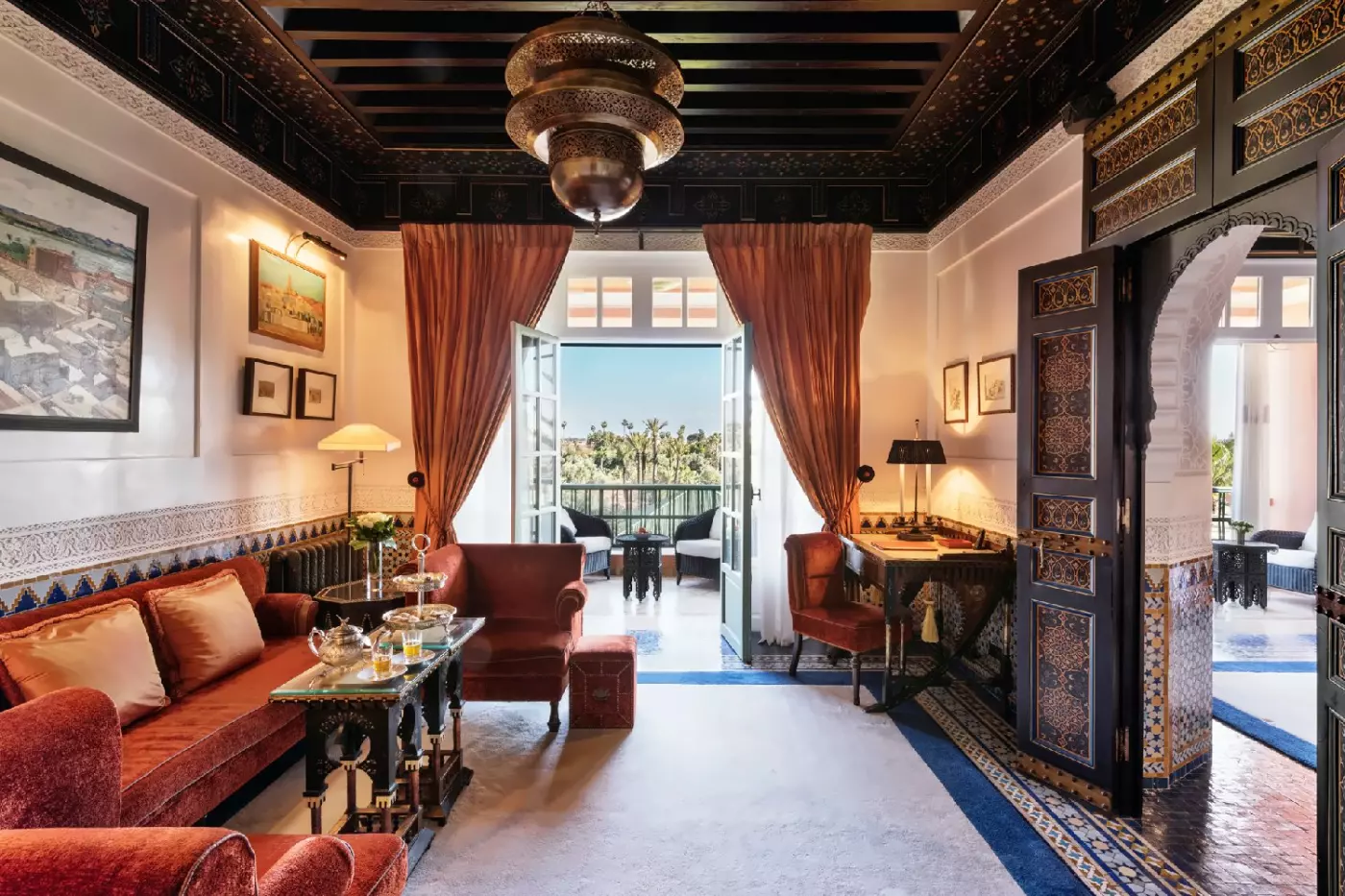
A dark carved lintel frames the sitting area beside the bedroom. Rich red curtains and a padded chair contrast with the cream walls, while the bedrunner adds the same colour to the sleeping space. Small mosaic tiles sit below a finely patterned plaster border.
The suite faces the hotel’s main entrance, with a balcony extending the separate lounge outdoors. Pale marble runs below warm ochre walls in the bathroom. A basin stands on a narrow counter beneath a dark-framed mirror. The arched shower recess sits apart from the freestanding bathtub, with patterned tile borders and softly lit stone around them.

A dark carved lintel frames the sitting area beside the bedroom. Rich red curtains and a padded chair contrast with the cream walls, while the...
The bedroom is at garden level; the lounge and another terrace are upstairs.
Tiled stairs rise beside a dark wooden lattice screen. A rounded, carved headboard anchors the sleeping area, with a black upholstered bench at its foot. Cream walls and an ochre bedrunner are picked up by deep red chairs and curtains. A writing desk stands beside the window.
Glass doors at garden level open straight onto a furnished patio, with greenery beyond its shutters. In the bathroom, veined marble covers the floor and lower walls. A dark-framed mirror hangs above the white basin, while an arched recess surrounds the shower.

Tiled stairs rise beside a dark wooden lattice screen. A rounded, carved headboard anchors the sleeping area, with a black upholstered bench at its foot....
A balcony is included in selected suites.
A dark timber headboard gives the bedroom a clear centre, with a burgundy runner over white bedding. Pale walls and a carved ceiling border frame the lighter details and artwork. Dark bedside tables and a writing desk furnish the sleeping area.
Green seats gather around small carved tables in the lounge. In selected layouts, white sculpted arches lead towards the outdoor space. Mosaic tiles cover the floor and lower walls, below decorative niches and a hanging lantern. The suites occupy the hotel’s middle floors, close to the main lifts. Bespoke furniture and marble bathroom finishes complete the interior.

A dark timber headboard gives the bedroom a clear centre, with a burgundy runner over white bedding. Pale walls and a carved ceiling border frame...
A carved arch on slender columns joins the bedroom and lounge. Dark red timber contrasts with pale plaster and the small patterned tiles below. A writing desk and padded seats stand near the softly curved headboard.
In the lounge, brown armchairs gather beneath an ornate mirror. Framed photos and hanging lanterns sit among the carved ceiling details, bringing a rich mix of textures to these rooms. Arches also shape the bathroom’s bathing alcove. Here, strongly veined marble meets warm, plain upper walls, while a dark mashrabiya wood screen adds a finer pattern beside the window.

A carved arch on slender columns joins the bedroom and lounge. Dark red timber contrasts with pale plaster and the small patterned tiles below. A...
Daylight comes through turquoise French doors beside the dark rounded headboard and pale walls. Red curtains match the bedrunner, adding warmth around the bedside lamps with green bases. Framed photos hang below the carved plaster border.
A carved wooden arch opens into the lounge, where deep red seats and gold cushions gather at a small table. The ceiling is green above the dark woodwork. In the bathroom, marble covers the floor and counter beneath two white basins and dark-framed mirrors. Wood screens and alcoves around the bath bring the same Moroccan craft into this part of the suite.

Daylight comes through turquoise French doors beside the dark rounded headboard and pale walls. Red curtains match the bedrunner, adding warmth around the bedside lamps...
Pale walls and a carved plaster border surround the bedroom. An ochre runner crosses the bed, and a red armchair sits beside the window. Dark curtains frame turquoise doors near the rounded headboard. Photos and green-based lamps add detail to the bedside setting.
Carved wood and coloured tiles bring the same Moroccan style into the lounge, with rich fabrics on the seats. An ornate arch marks the passage to the separate bedroom. In the bathroom, deeply veined marble covers the floor and lower walls below a strip of patterned tiles. Red upper walls rise above the pale stone, with a hanging lantern beside the arched bathing recess.

Pale walls and a carved plaster border surround the bedroom. An ochre runner crosses the bed, and a red armchair sits beside the window. Dark...
Dark red curtains frame the French doors across the bedroom wall. An ochre bedrunner and red armchair bring warm colour to the carved, rounded headboard. Pale plaster keeps the upper walls light, with a desk and bedside lamps furnishing the sleeping space.
Woven chairs and a small round table sit behind the balcony railing. From these upper floors, the Atlas Mountains form a distant backdrop beyond the palms. A separate lounge has carved wood, tiled walls and rich red and gold fabrics in the traditional Moroccan style. The marble bathroom also has mashrabiya wooden screens, adding a fine pattern to the stone.

Dark red curtains frame the French doors across the bedroom wall. An ochre bedrunner and red armchair bring warm colour to the carved, rounded headboard....
Windows wrap around the curved lounge’s Menzeh-style rotunda, with light curtains framing the glass. Soft seats gather at a table high enough for dining. From the third floor, daylight falls on pale decor and fine carved details.
Carved plaster borders join zellige tiles and wooden ceilings painted by hand. A tall wood arch links the living spaces, with ornate carving above furniture in light tones. The bedroom sits beside two lounges. Decorated doors open to the bathroom, where veined marble meets warm gold-toned plaster above the bath alcove.

Windows wrap around the curved lounge’s Menzeh-style rotunda, with light curtains framing the glass. Soft seats gather at a table high enough for dining. From...
Two lounges offer distinct spaces around the separate bedroom. In the red-walled sitting room, a pale sofa faces a round coffee table beneath an ornate mirror. Warm cushions soften the seats, with dark curtains and carved plaster around the windows and doors.
A broad wooden headboard, burgundy runner and padded bench furnish the bedroom. A patterned chair sits at the writing desk beside the glass doors. Sculpted wood meets zellige tiles and rich woven fabrics throughout the decor. Pale marble with strong veins covers the bathroom floor and lower walls, with deep red walls above. Arched recesses and a hanging lantern add detail around the bathing space.

Two lounges offer distinct spaces around the separate bedroom. In the red-walled sitting room, a pale sofa faces a round coffee table beneath an ornate...
White taffeta drapes above the canopy bed in this ivory and cream interior. Inlaid wood and decorative plaster stand out against the soft palette. A pale padded chair and foot bench sit near the bed, with light curtains framing the French doors.
Curved cream sofas face a round wooden table in the lounge. A dark timber ceiling and hanging lantern rise above them. Portraits of Berber brides add a local note here, while photos of famous film couples decorate the bedroom. Patterned curtains and carved wood give texture to the pale fabrics. Veined marble and zellige motifs extend this mix of materials into the bathroom.

White taffeta drapes above the canopy bed in this ivory and cream interior. Inlaid wood and decorative plaster stand out against the soft palette. A...
Tartan armchairs and deep red fabrics bring a British touch to this Moroccan interior. Dark shelves flank a red alcove with a portrait and a replica of Churchill’s London statue. A round table and patterned chairs sit below the carved timber details.
His name appears above the bedroom’s headboard, with framed photos nearby. Red curtains surround turquoise French doors, and a plaid chair adds another link to the suite’s namesake. A lounge sits between the two sleeping rooms. Marble floors and counters give the bathrooms lighter tones, while dark-framed mirrors and red upper walls echo the colours of the living spaces.

Tartan armchairs and deep red fabrics bring a British touch to this Moroccan interior. Dark shelves flank a red alcove with a portrait and a...
Blue tiles and painted panels bring Majorelle’s colour scheme into the suite. Bright orange curtains and fabrics contrast with these tones, while the artist’s portrait hangs at the entrance. Dark wood and carved plaster arches frame the walls, with a shine from the zellige mosaics.
A curved rotunda-style window faces the grounds from one bedroom. Orange curtains frame turquoise doors near a pale carved headboard and dark wall panels. In the lounge, armchairs gather at small tables below a finely carved wood ceiling. The bathrooms have marble finishes in La Mamounia’s traditional style.

Blue tiles and painted panels bring Majorelle’s colour scheme into the suite. Bright orange curtains and fabrics contrast with these tones, while the artist’s portrait...
Wood panels and sleek 1920s furniture give this interior its Art Deco style. It carries through the bedrooms and lounge, with paintings on wood showing scenes of Moroccan life. Pale fabrics and curtains soften the clean lines of the joinery.
A desk runs along the bedroom wall beside dark lamps. The bedcover has a geometric pattern that echoes the vertical lines behind it. In the lounge, light padded seats gather at low tables facing the balcony doors. White sculpted arches link this space to a dining room and study. A broad table sits beneath a geometric pendant light there. Each bedroom has its own marble bathroom, with separate bath and shower areas.

Wood panels and sleek 1920s furniture give this interior its Art Deco style. It carries through the bedrooms and lounge, with paintings on wood showing...
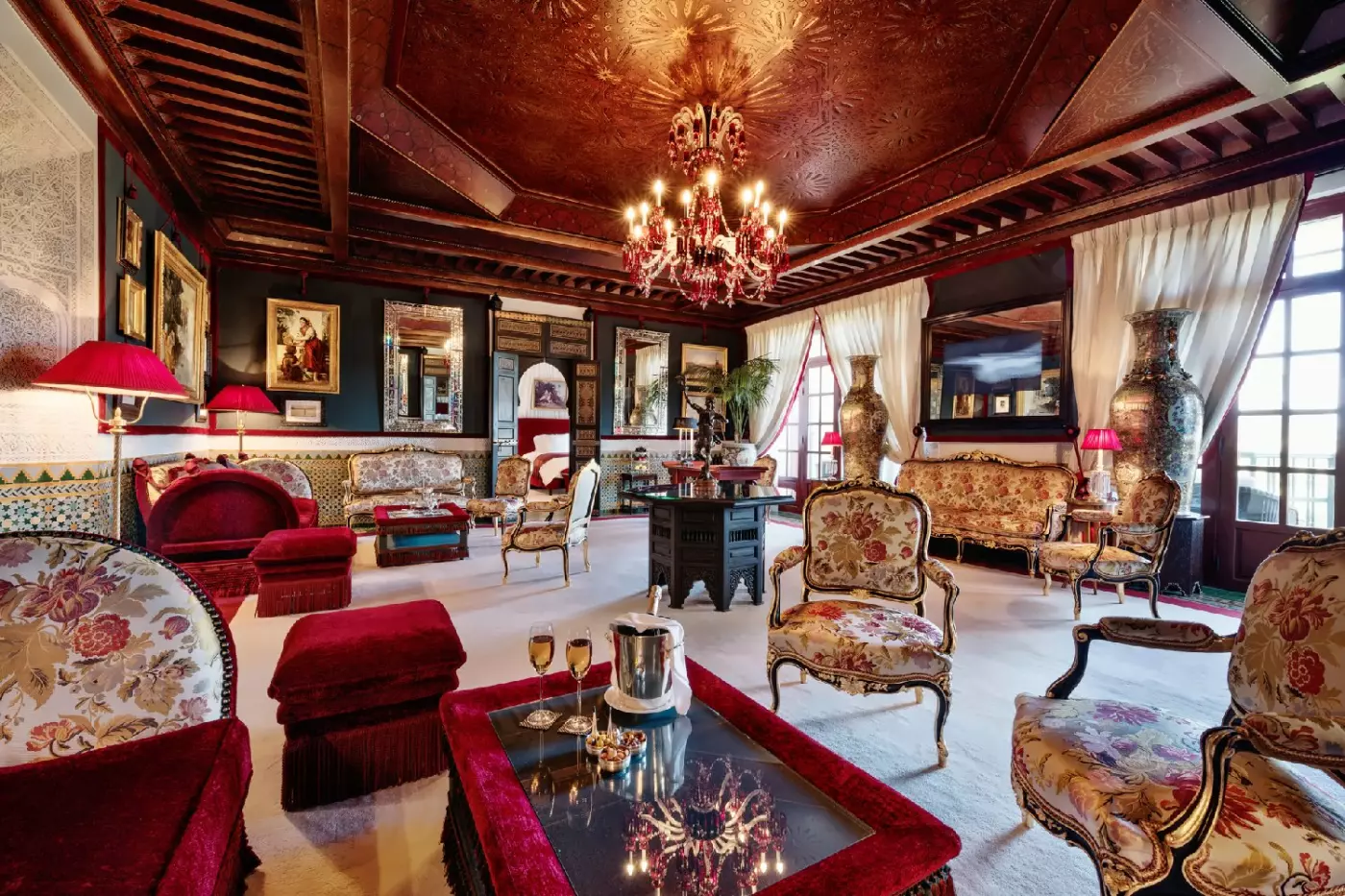
A grand chandelier hangs below the lounge’s finely carved wooden ceiling. Floral armchairs and deep red velvet bring colour to the dark furniture, with paintings around the room. Chinese vases stand on raised bases beside the large French windows.
The bedrooms mix sculpted wood, chiselled plaster and zellige mosaics. Richly padded headboards sit below patterned borders, with light curtains around the windows. Lamps and mirrors add detail to the smaller spaces. Both bedrooms have dressing rooms, and a spacious lounge sits apart from the sleeping areas. Red upper walls meet strongly veined marble in the bathrooms. White basins rest on narrow counters, with freestanding tubs in a pale stone setting.

A grand chandelier hangs below the lounge’s finely carved wooden ceiling. Floral armchairs and deep red velvet bring colour to the dark furniture, with paintings...
A tiled patio forms the centre of the house, with arched columns opening towards the terrace. Green and black zellige patterns cover the pillars. Broad tiled steps and carved plaster frame the courtyard, while sun loungers and umbrellas sit by the water within the garden walls.
A carved timber ceiling rises above the dining room’s large table and padded chairs. White arches link this room to the lounge, with geometric marble and tiles across the floor. Each bedroom has a bathroom with separate bath and shower areas. A guest bathroom serves the living spaces.
The kitchen provides space to prepare meals and snacks within the house. Traditional Moroccan materials meet modern furniture throughout the interior.

A tiled patio forms the centre of the house, with arched columns opening towards the terrace. Green and black zellige patterns cover the pillars. Broad...
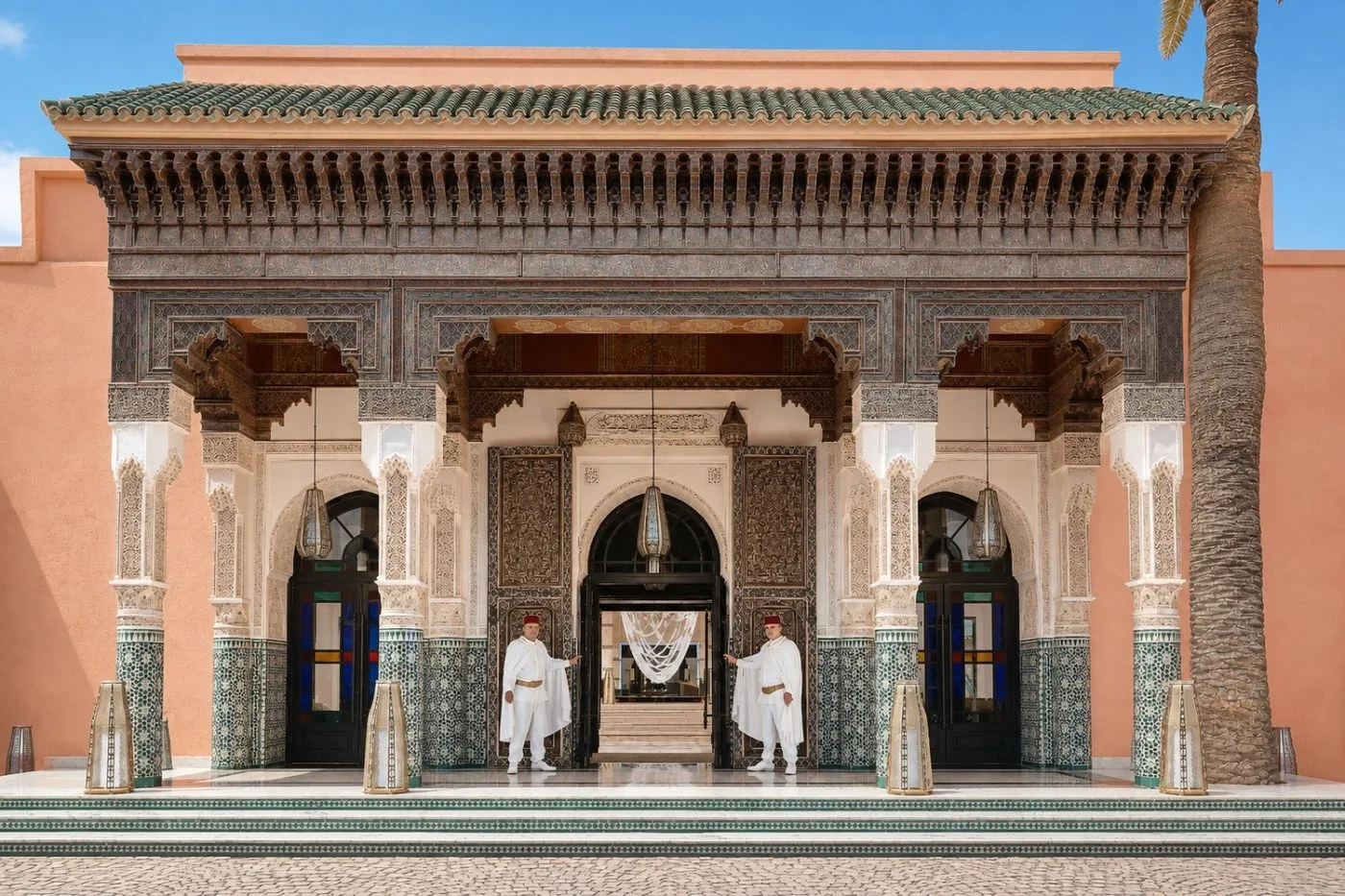
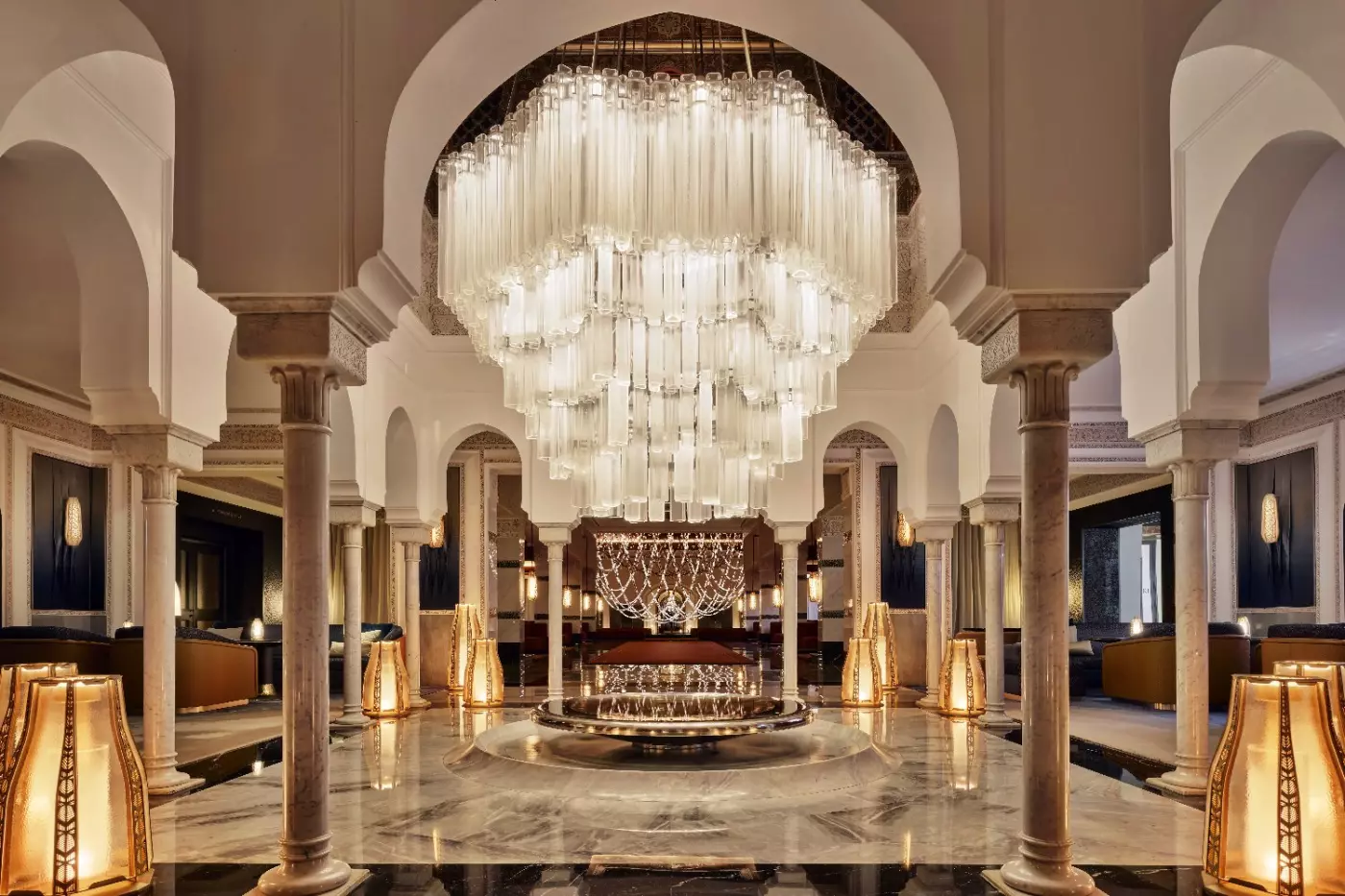
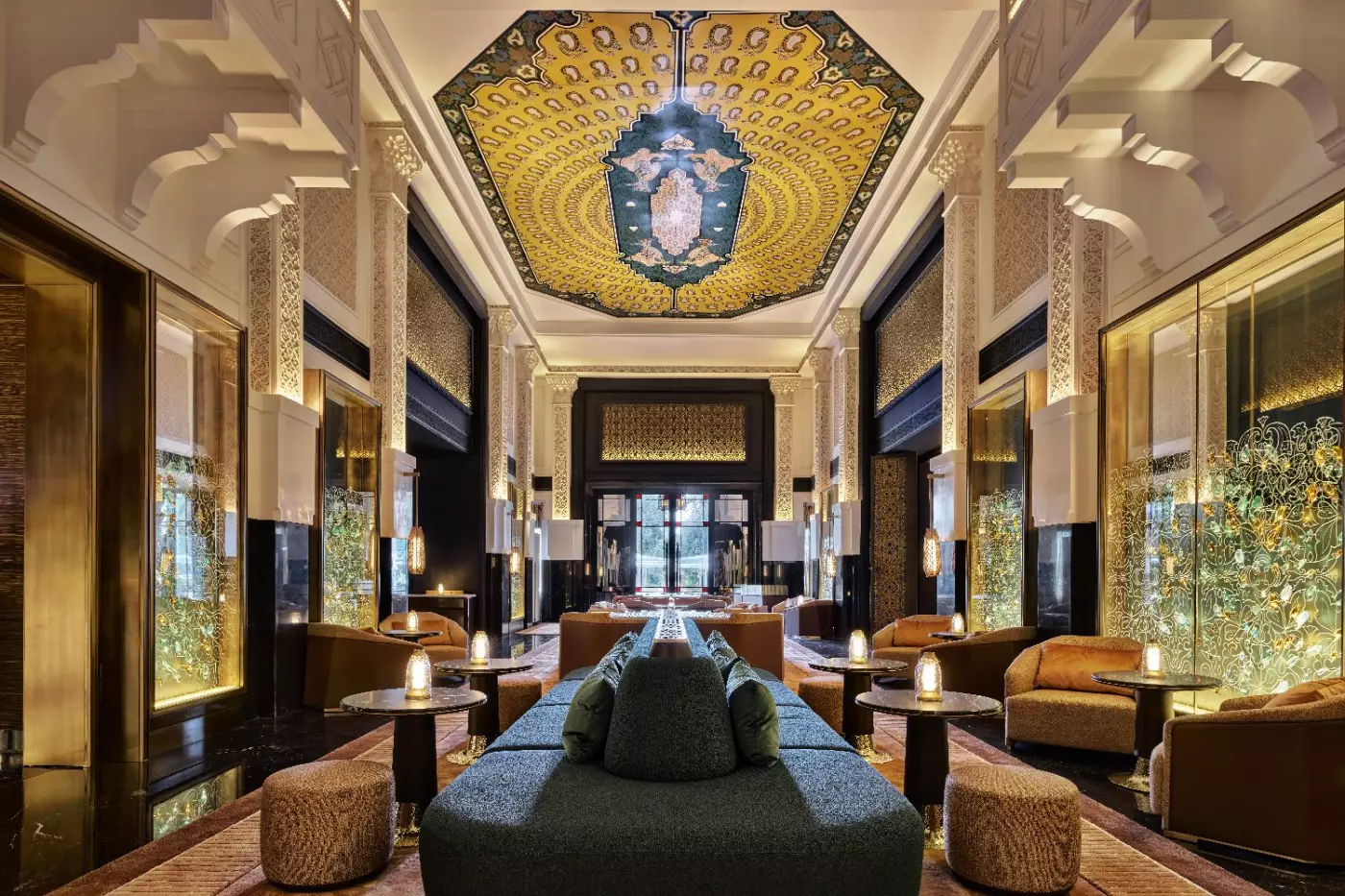
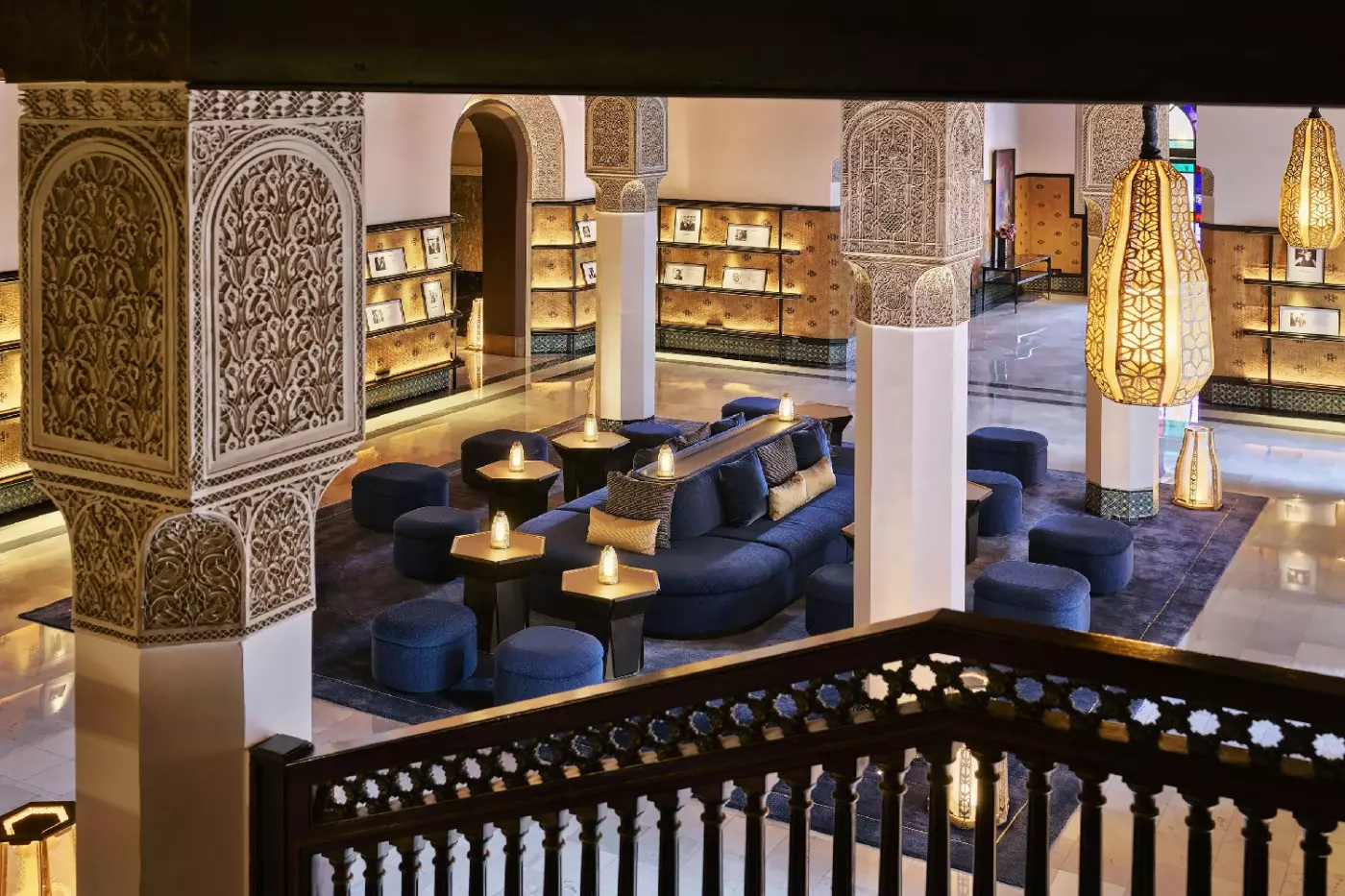
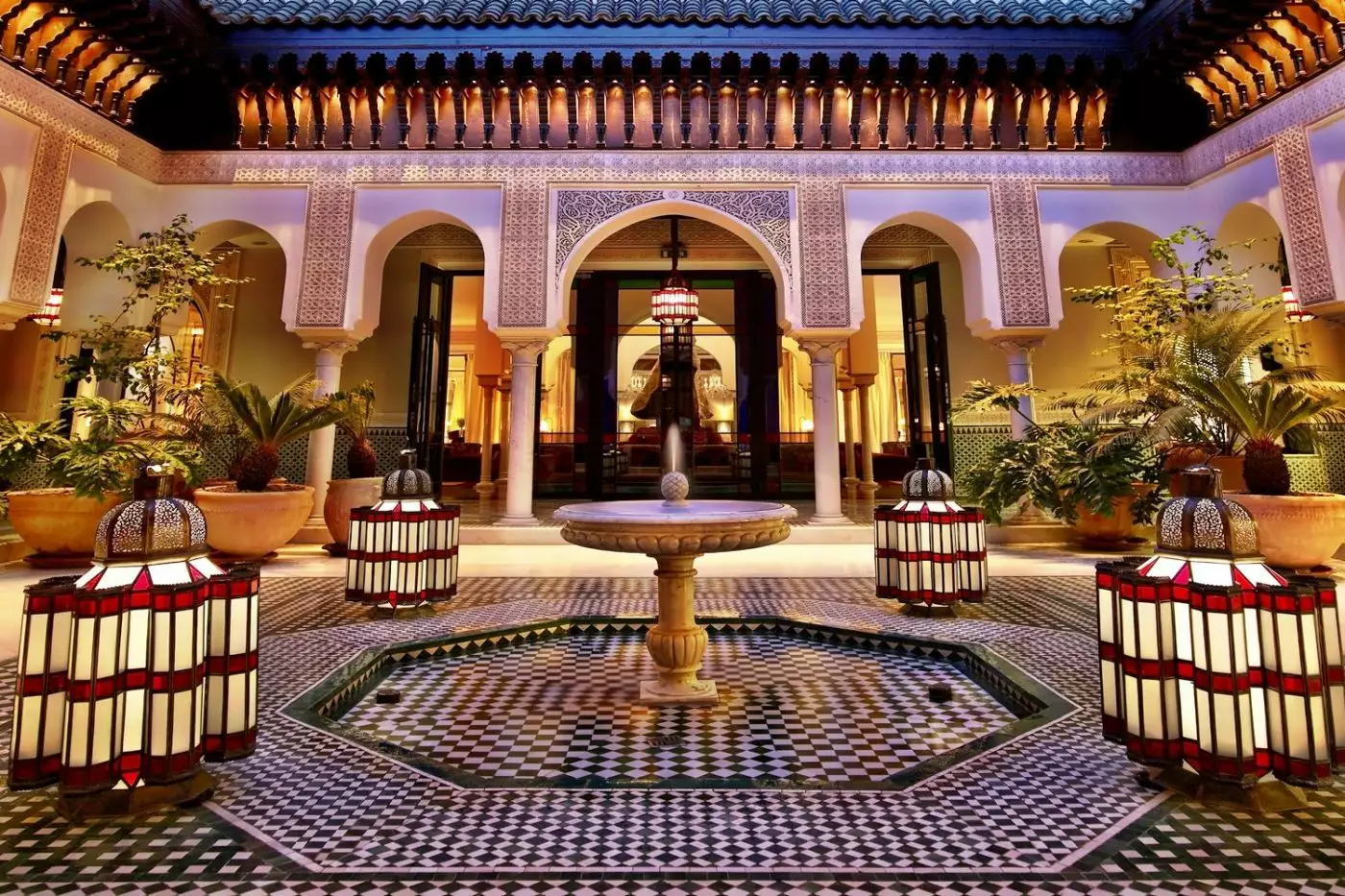
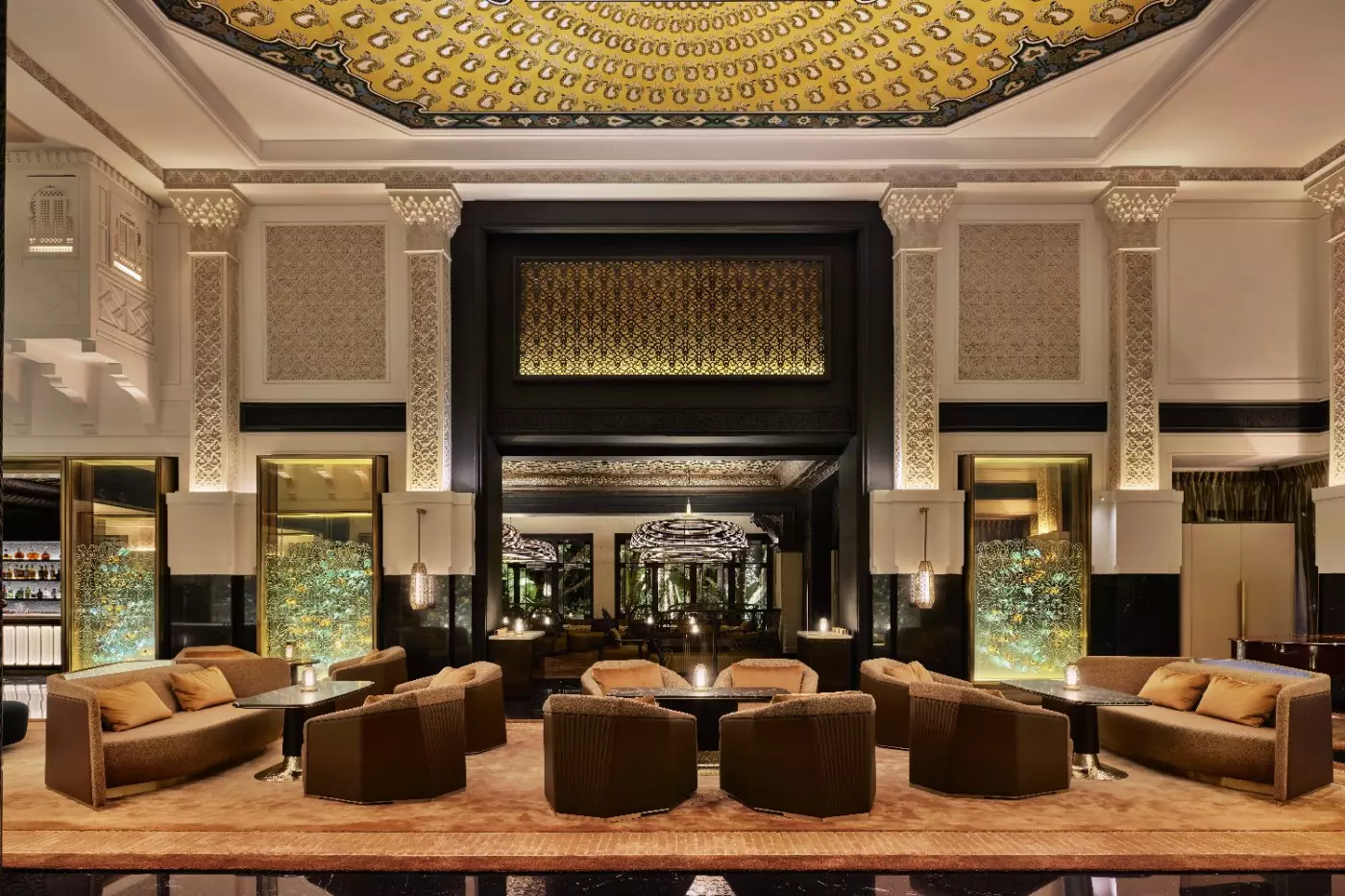
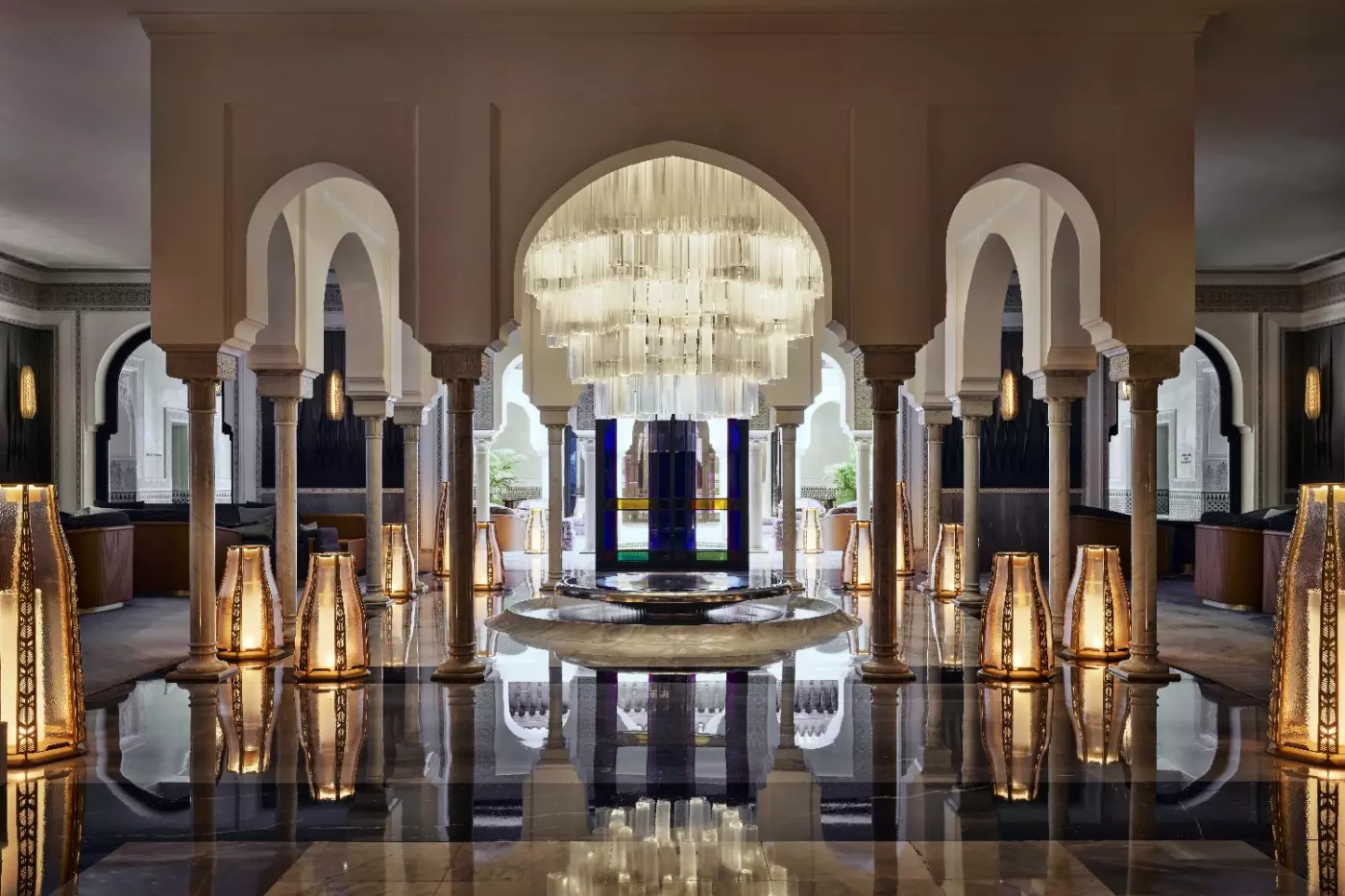
La Mamounia opened in 1923 and remains one of the hotels that defines Marrakech for international travelers. Its 2020 refurbishment kept the Art Deco and Moroccan craft language while refreshing the restaurants, bars, rooms, and public spaces. The result is not a quiet minimalist hotel. It is a layered palace with zellige, carved plaster, woodwork, lanterns, garden views, patterned floors, and a level of ceremony that feels deliberate from arrival onward.
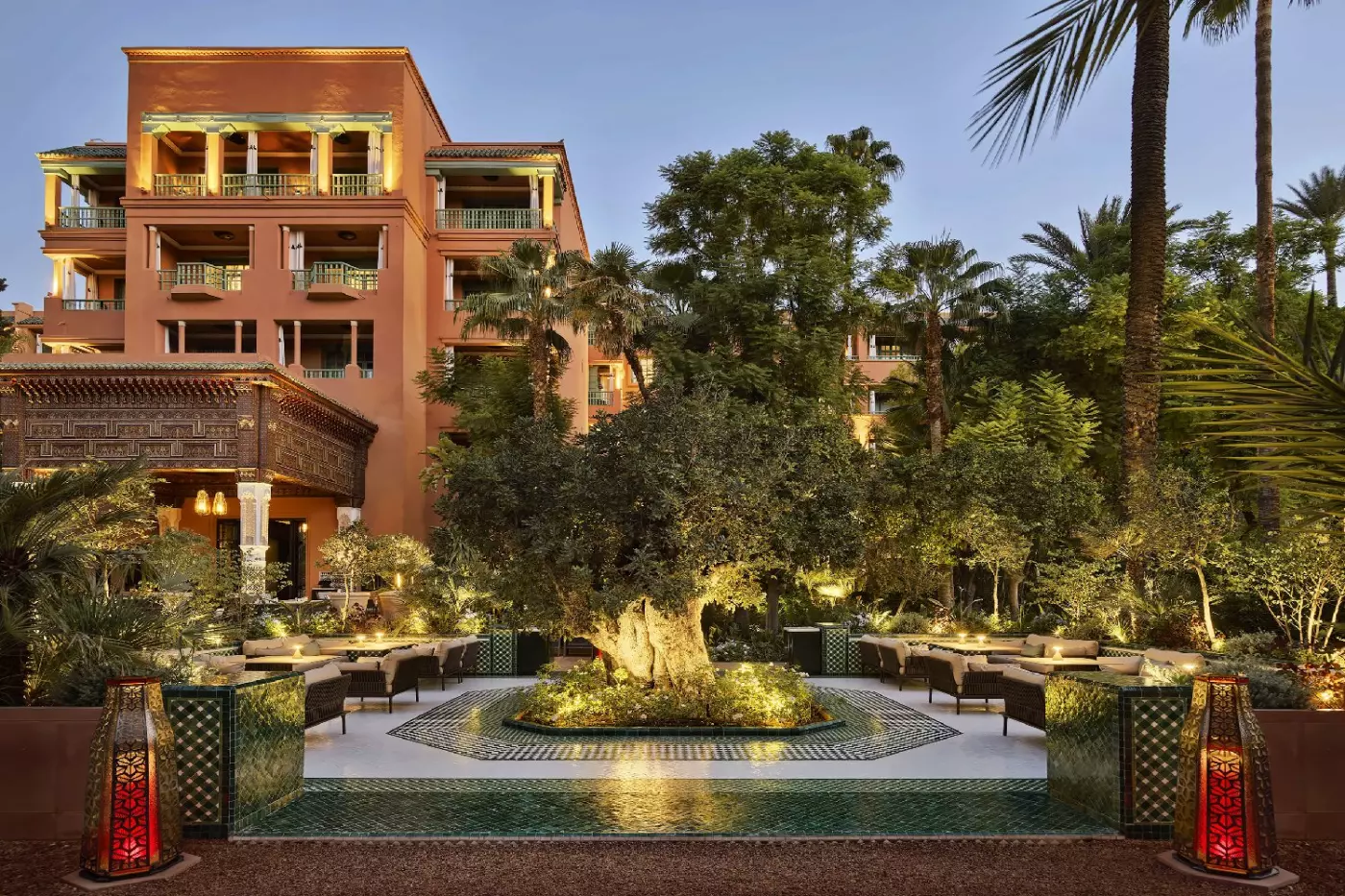
The hotel works because it does not separate guests from the city completely. It sits on Avenue Bab Jdid, beside the 12th-century ramparts and close to the Koutoubia Mosque, Jemaa el-Fna, the souks, and Hivernage. Taxis or drivers are easy for Gueliz, Majorelle Garden, Dar El Bacha, museums, galleries, golf, and Palmeraie dinners. Yet once inside, the gardens create enough distance from the street to make the hotel feel like its own address.
The accommodation range is broad. There are 135 rooms, 71 suites, and 3 riads for guests who want more privacy. Rooms can feel compact compared with newer villa resorts, so category choice matters. Garden views, terrace space, and suite proportions make a real difference here. The riads are the right answer for travelers who want La Mamounia's services and setting, but need a more secluded stay with private living space and pool-style retreat.
Design is one of the main reasons to book. The rooms use Moroccan craftsmanship, warm colors, carved details, marble, carpets, and garden-facing calm rather than the glass-and-steel language of many newer luxury hotels. Some guests will prefer the quieter polish of Royal Mansour's private riads or Mandarin Oriental's villas. La Mamounia is better for travelers who enjoy a grand hotel rhythm: breakfast, garden, pool, spa, bar, dinner, and a steady sense of people moving through beautiful rooms.
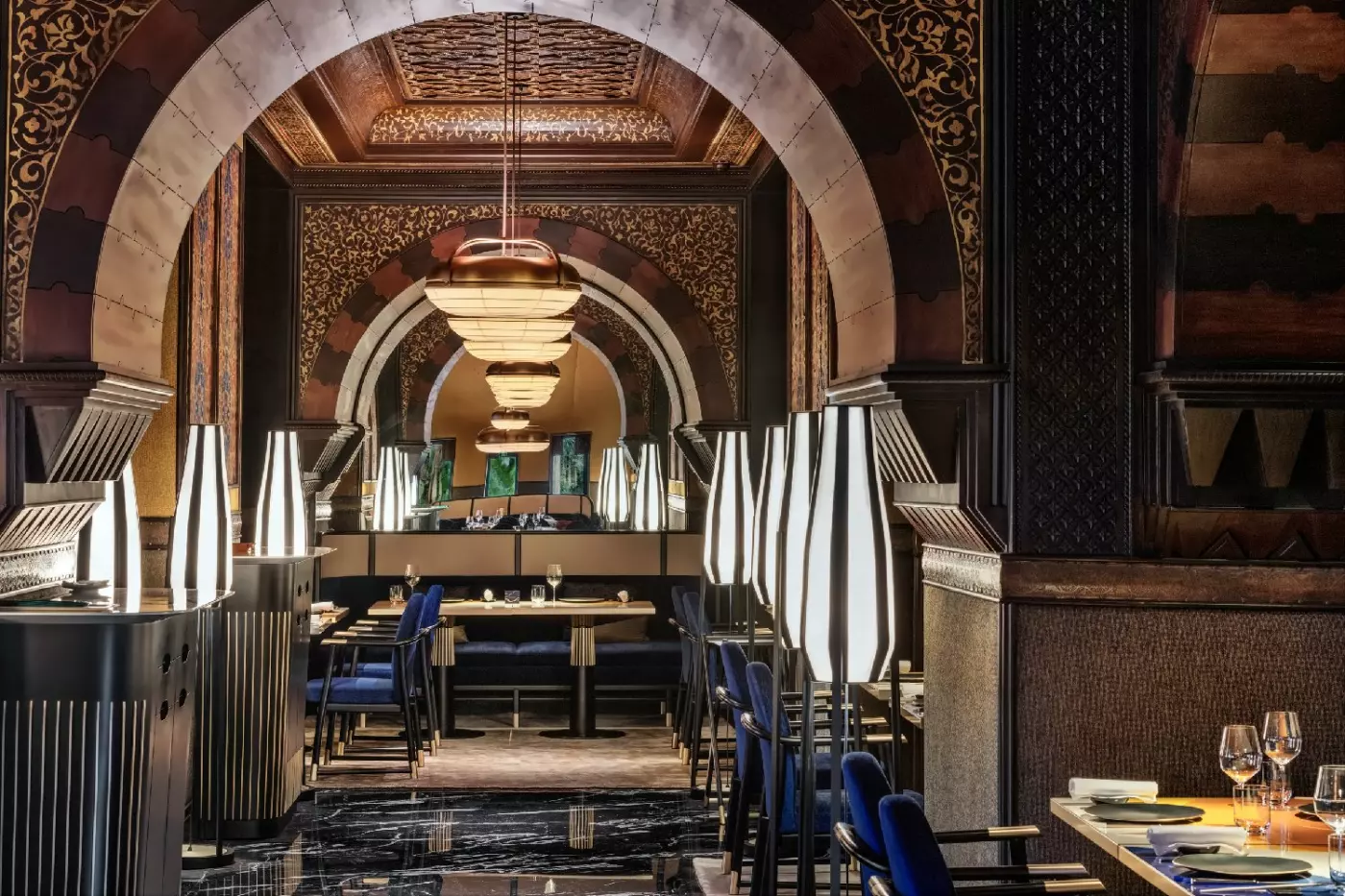
Dining is a major part of the current La Mamounia offer. The hotel has four restaurants, four bars, and two Pierre Herme tea rooms. Le Marocain focuses on Moroccan flavors with chef Rachid Agouray. L'Italien is led by Simone Zanoni. L'Asiatique by Jean-Georges brings Asian influences into a more contemporary setting, while Le Pavillon de la Piscine handles poolside dining. This range gives the hotel more depth than many city-palace competitors.
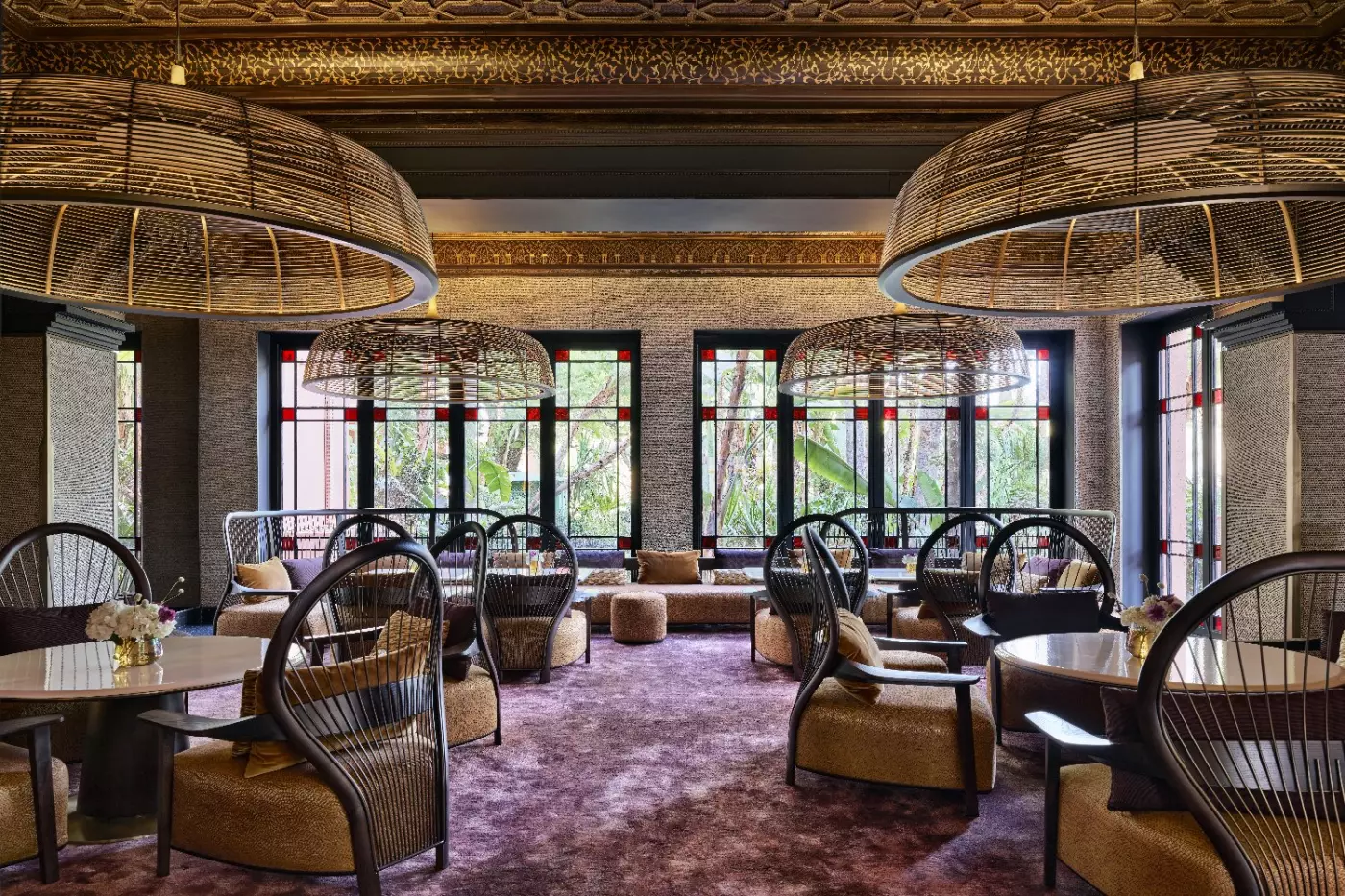
The drinks and tea-room program also matters. Le Churchill carries the hotel's classic bar identity, while Le Bar Majorelle, Le Club, and Le Bar de la Piscine create different moods across the property. Le Menzeh by Pierre Herme and Le Salon de The by Pierre Herme make pastry and tea part of the stay, not an afterthought. Guests who like to dine out in Marrakech should still reserve outside restaurants, but La Mamounia can easily hold two or three evenings on its own.
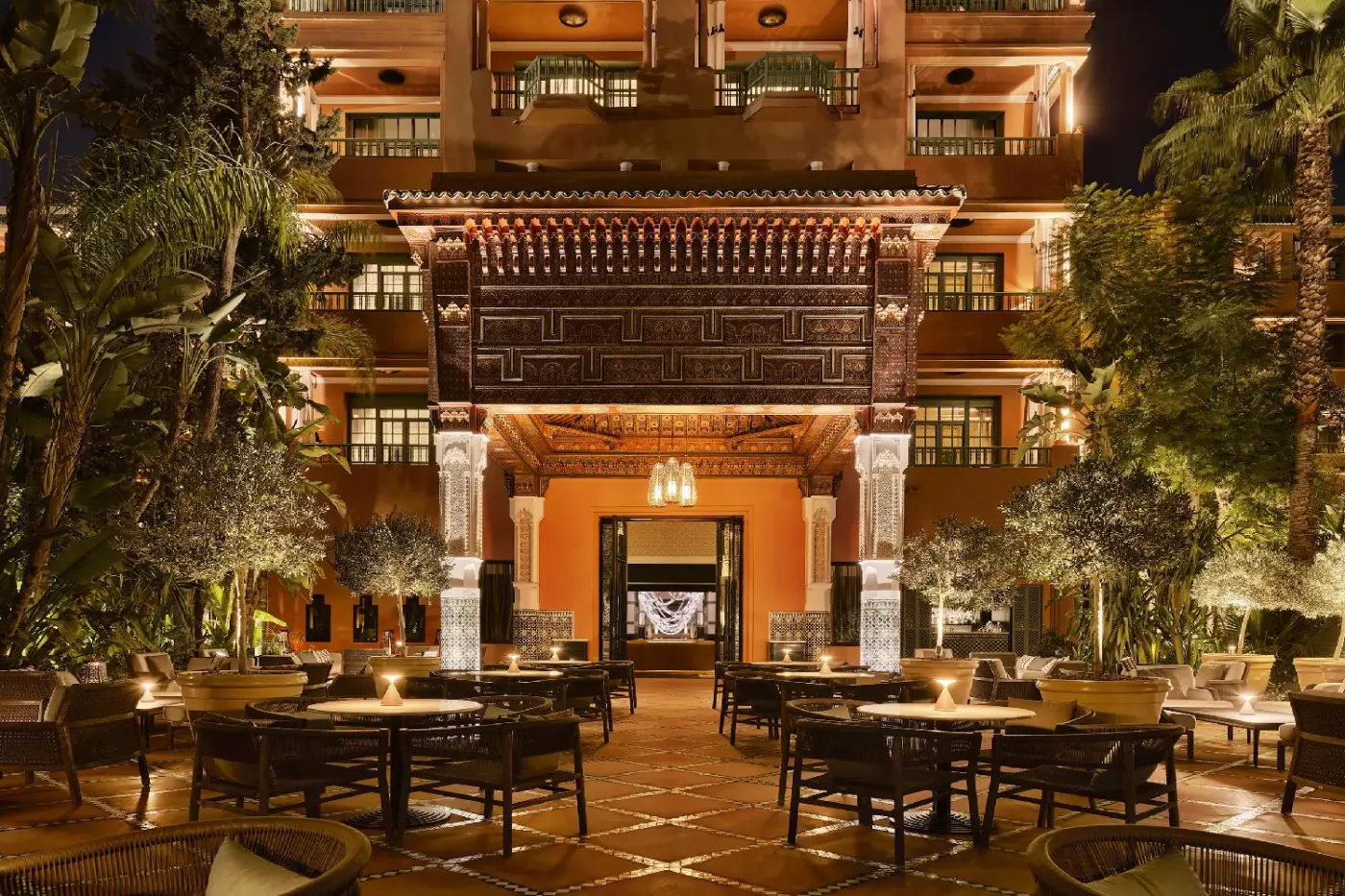
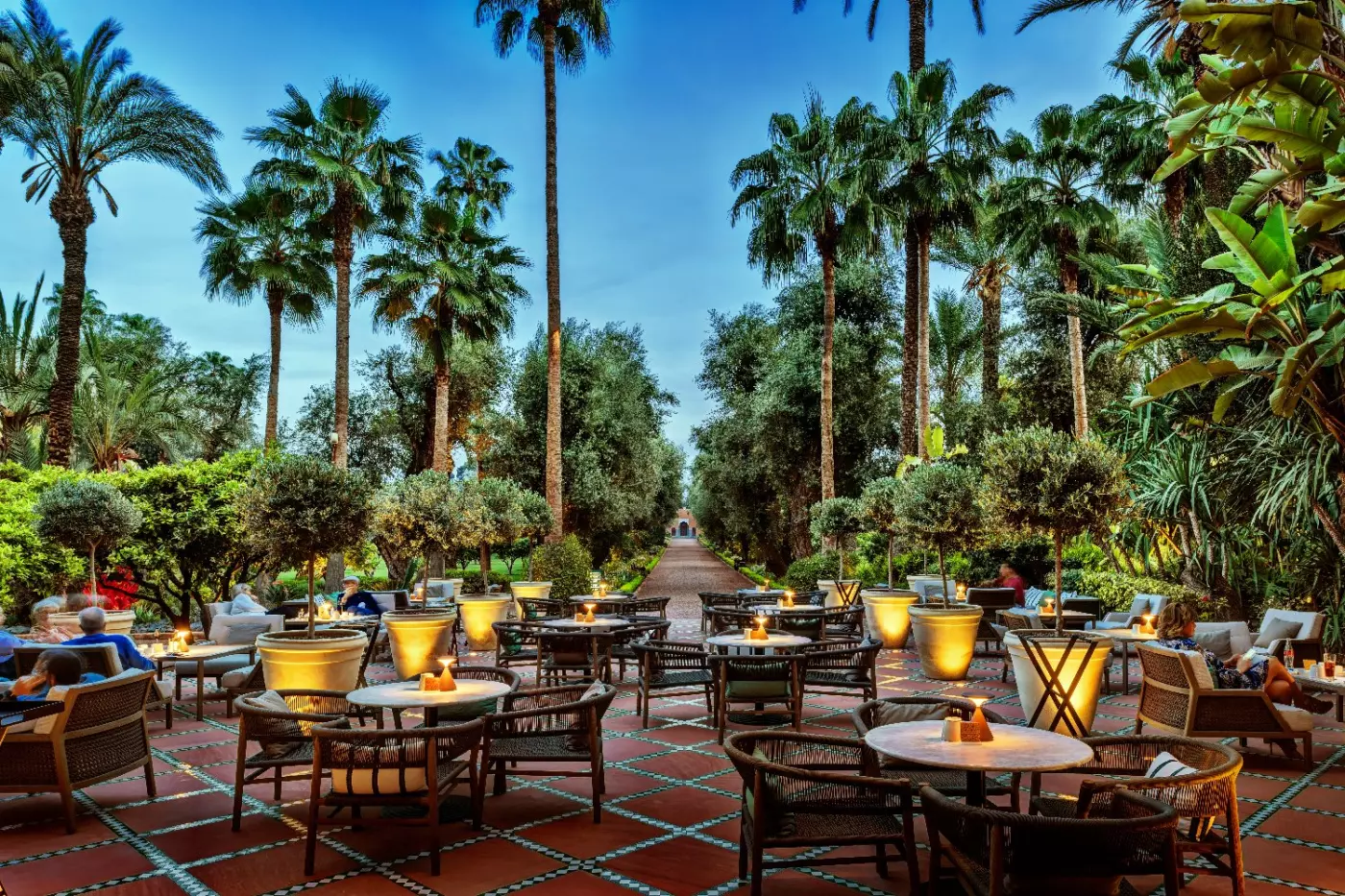
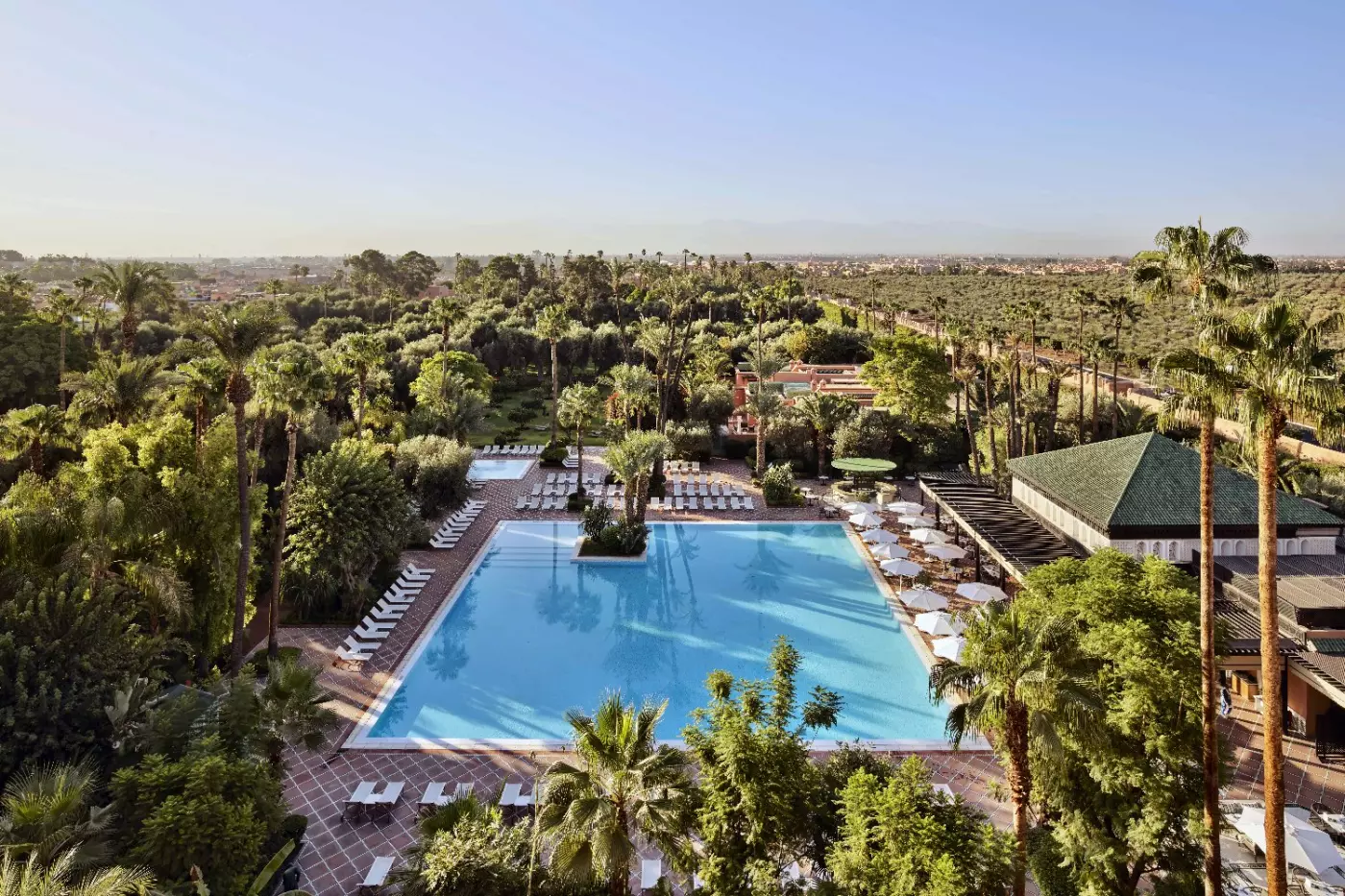
The gardens are central to the hotel. Spread across roughly 17 acres, they include palms, olive trees, citrus, roses, paths, lawns, and a 1,500 square meter vegetable garden. The garden is not just scenery. It shapes the way the hotel breathes. Guests can spend a morning in the medina, return for lunch by the pool, walk through shaded paths, and then move into the spa or one of the bars before dinner.
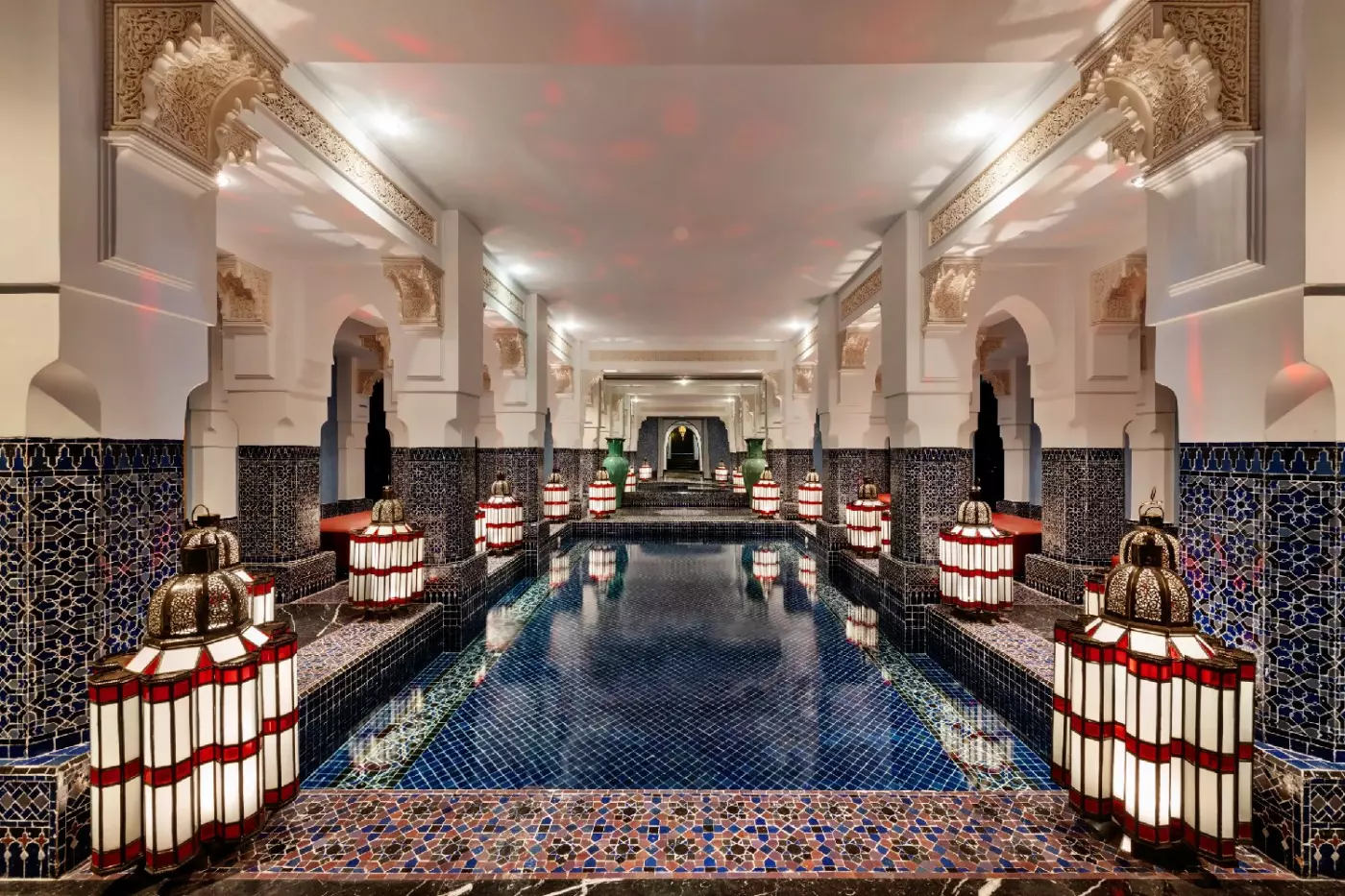
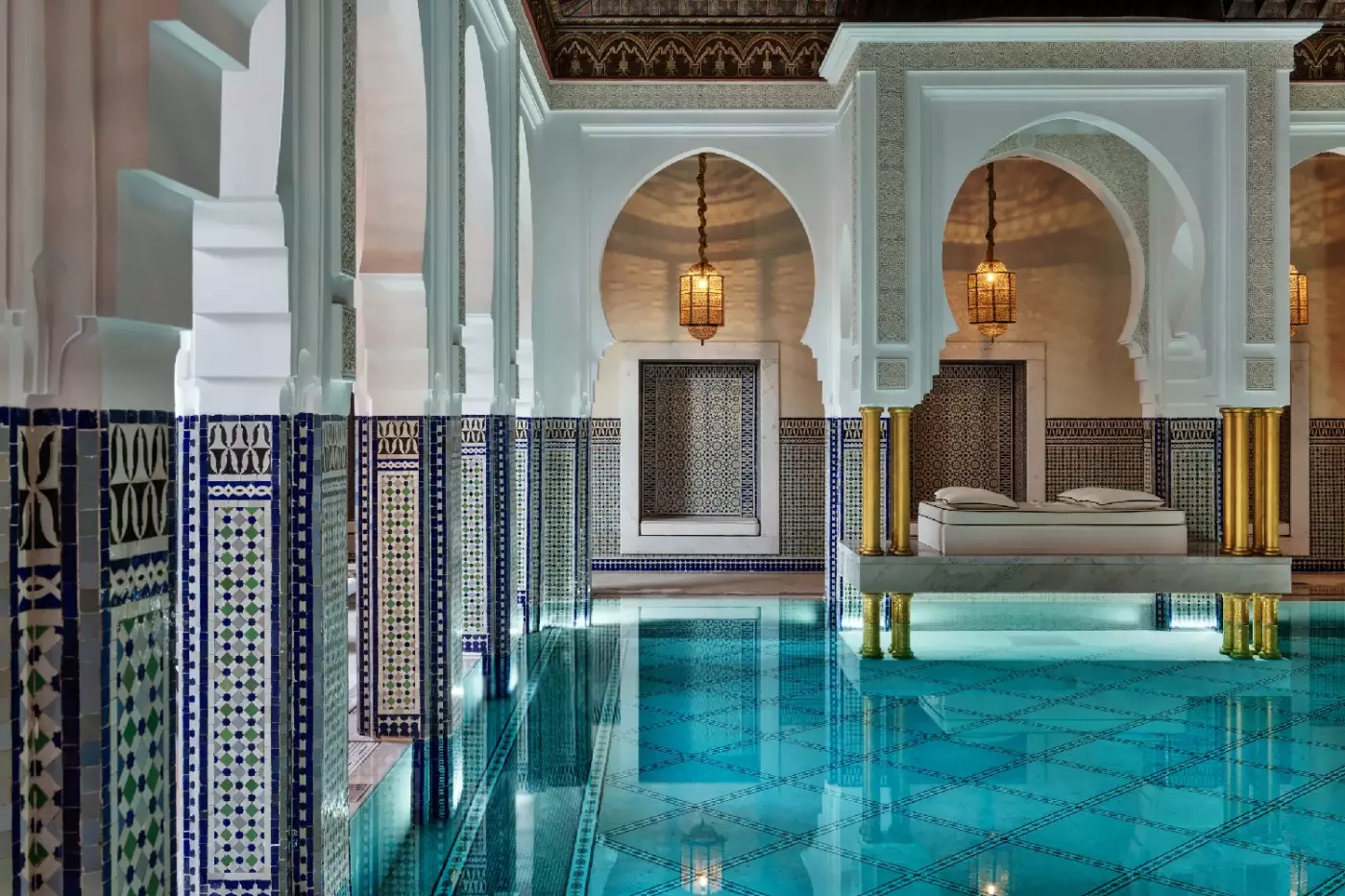
The spa adds the other half of that rhythm. La Mamounia has a large wellness area with hammam rituals, treatment rooms, indoor pool, fitness areas, and classic Moroccan bathing culture. It is not as private or architecturally singular as the Royal Mansour spa. It is also not a remote resort wellness program. Its strength is convenience and atmosphere. Spa time sits naturally between city visits, pool time, and dinner, which makes the hotel work especially well for short Marrakech stays.
Royal Mansour Marrakech is the stronger choice for guests who want full riad privacy, exceptional service choreography, and one of the city's most dramatic spas. Mandarin Oriental Marrakech offers larger villa-style space and a calmer resort setting outside the medina core. Amanjena is best for travelers who want a quieter, more spread-out retreat away from the city center. Selman Marrakech leans into Arabian horse culture and resort mood. Nobu Hotel Marrakech is more urban and contemporary.
La Mamounia wins when the guest wants Marrakech's grand hotel at the edge of the old city. It has more public life than Royal Mansour, more history than many villa resorts, and more immediate medina access than the outer properties. It is also better for travelers who enjoy a famous address with restaurants, bars, gardens, and people-watching. It is less ideal for guests who want total discretion, maximum room size, or a silent private-villa stay.
Book La Mamounia if you want a luxury hotel in Marrakech with heritage, scale, gardens, dining range, spa rituals, and a central position near the medina. It suits first-time Marrakech travelers, couples, design-minded guests, food lovers, short-break travelers from Europe, and guests who want the city to feel accessible without sleeping inside a small riad. It also works for travelers who like a hotel with energy rather than a retreat that hides every trace of movement.
Do not book it expecting the quietest hotel in Morocco. La Mamounia is alive, famous, and sometimes busy in the best and worst ways. That is part of its identity. The main reason to choose it is the complete package: 209 keys across rooms, suites, and riads, 17-acre gardens, four restaurants, four bars, Pierre Herme tea rooms, a major spa, and a location at the medina walls. Few 5-star hotels in Marrakech combine those elements with such cultural weight.
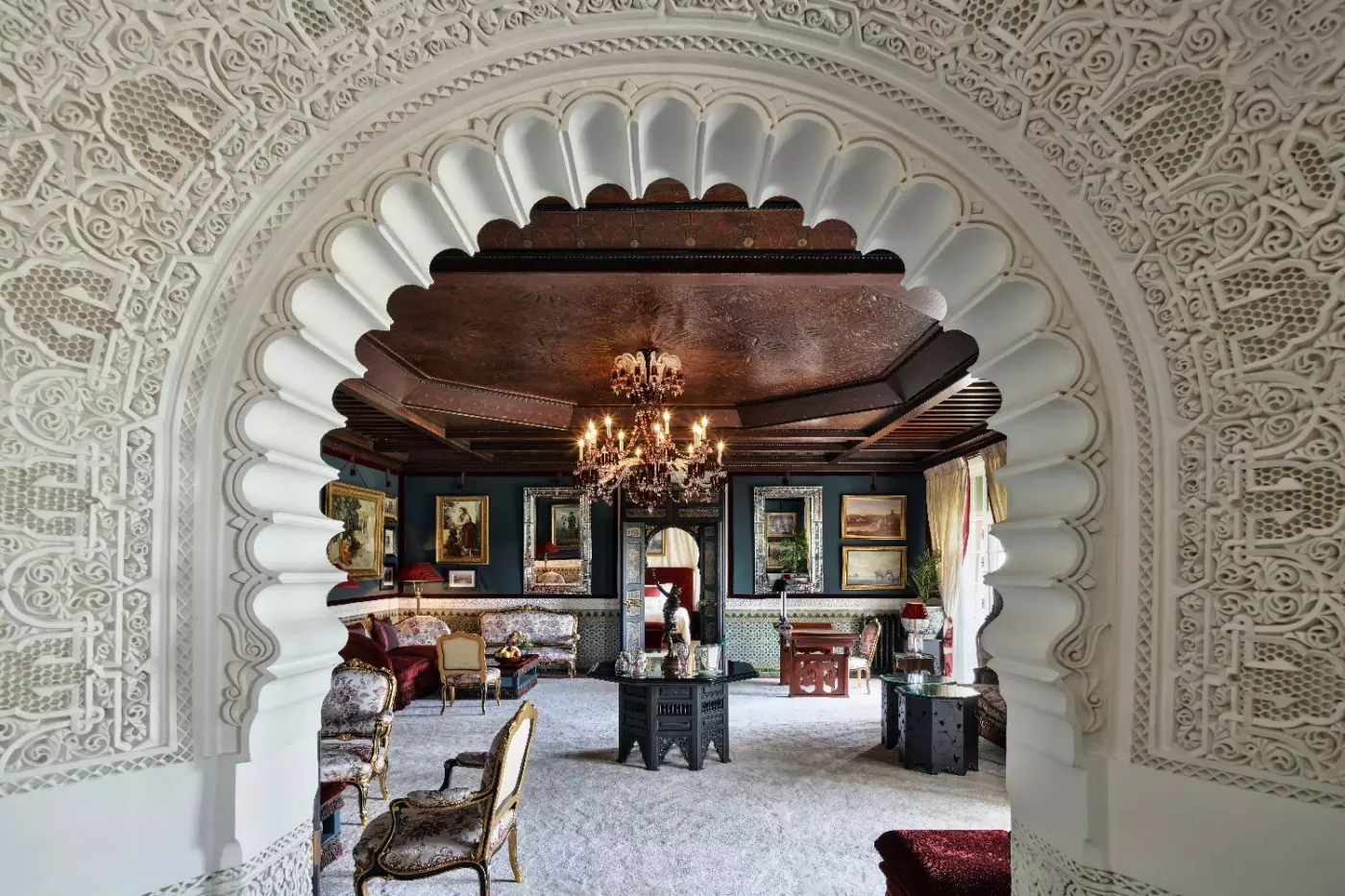
Moroccan woodwork, zellige, and mashrabiya carry local craft into the guest rooms, so the setting stays present throughout the visit.
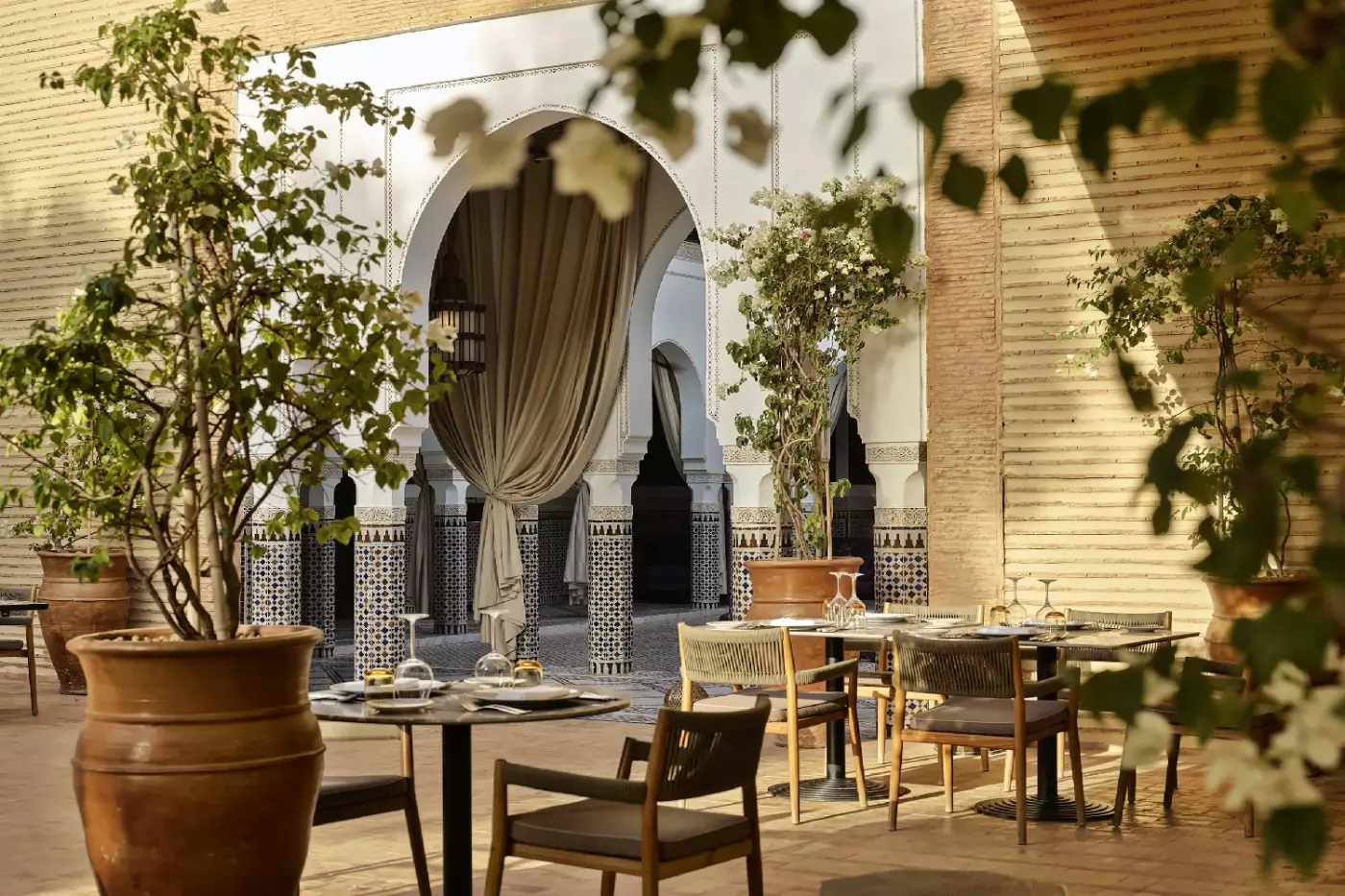
At Le Marocain, traditional Moroccan dishes are served in a three-story riad; the architecture becomes part of the evening.
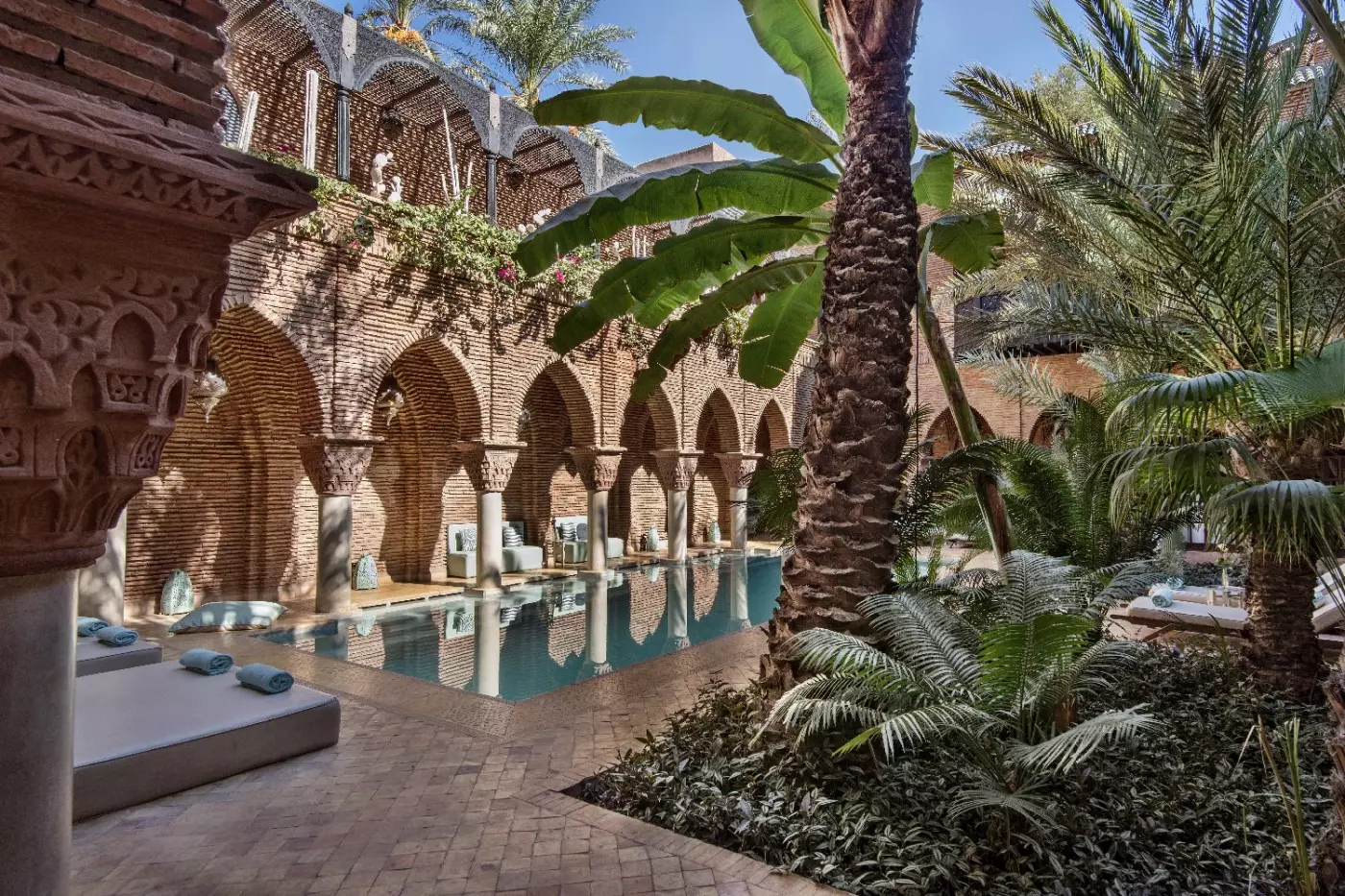
The large outdoor pool sits among the gardens, giving guests room to swim or linger without leaving the hotel grounds.
Avenue Bab Jdid, 40040 Marrakesh, Morocco
Playing this video may share data with YouTube. Please see our Privacy Policy.
La Mamounia is best for luxury travellers who want an iconic Marrakech palace with 209 keys, 135 rooms, 71 suites, 3 riads, historic gardens, four restaurants, Pierre Herme patisserie, a major spa, and a location near the Medina. It is less ideal for guests who want a tiny riad, a minimalist hotel, or complete seclusion from the city. For first-time Marrakech visitors, couples, food lovers, spa travellers, and guests who want one of Morocco's most famous hotel experiences, La Mamounia remains one of the strongest choices.
La Mamounia is better if you want a grand historic palace hotel with legendary gardens, multiple restaurants, a lively sense of place, and a classic Marrakech social atmosphere. Royal Mansour is better if you want ultra-private riad living with a more secluded, residential style of luxury. Both are top-tier Marrakech choices, but they feel different. Choose La Mamounia for heritage, gardens, restaurants, and iconic hotel energy. Choose Royal Mansour for maximum privacy and an all-riad concept.
La Mamounia is associated with Winston Churchill because he became one of the hotel's emblematic guests and is closely tied to its Marrakech legend. The hotel's history since 1923 includes a long line of famous visitors, but Churchill remains the name most strongly linked with its image. That history matters because La Mamounia is not only a place to sleep. It is part of Marrakech's cultural mythology, with architecture, gardens, political history, art, and travel glamour layered into the guest experience.
The spa at La Mamounia is one of the hotel's major reasons to stay. It is designed for hammam rituals, treatments, beauty services, fitness, and a deep sense of retreat within the palace, making it especially useful after Medina days or long flights. This is not a token hotel spa. It is part of the La Mamounia identity: sensual, polished, Moroccan in atmosphere, and large enough to make wellness a real part of the trip rather than a spare-hour activity.
Yes. Le Marocain is worth choosing if you want a refined Moroccan dinner inside one of Marrakech's most iconic hotels. The restaurant brings spices, local flavour, atmosphere, and a more formal sense of place to the La Mamounia dining experience. It is a strong first-night choice for travellers who want to arrive in Marrakech properly. The setting lets the meal feel connected to the city rather than simply placed inside an international palace hotel.
More amenities
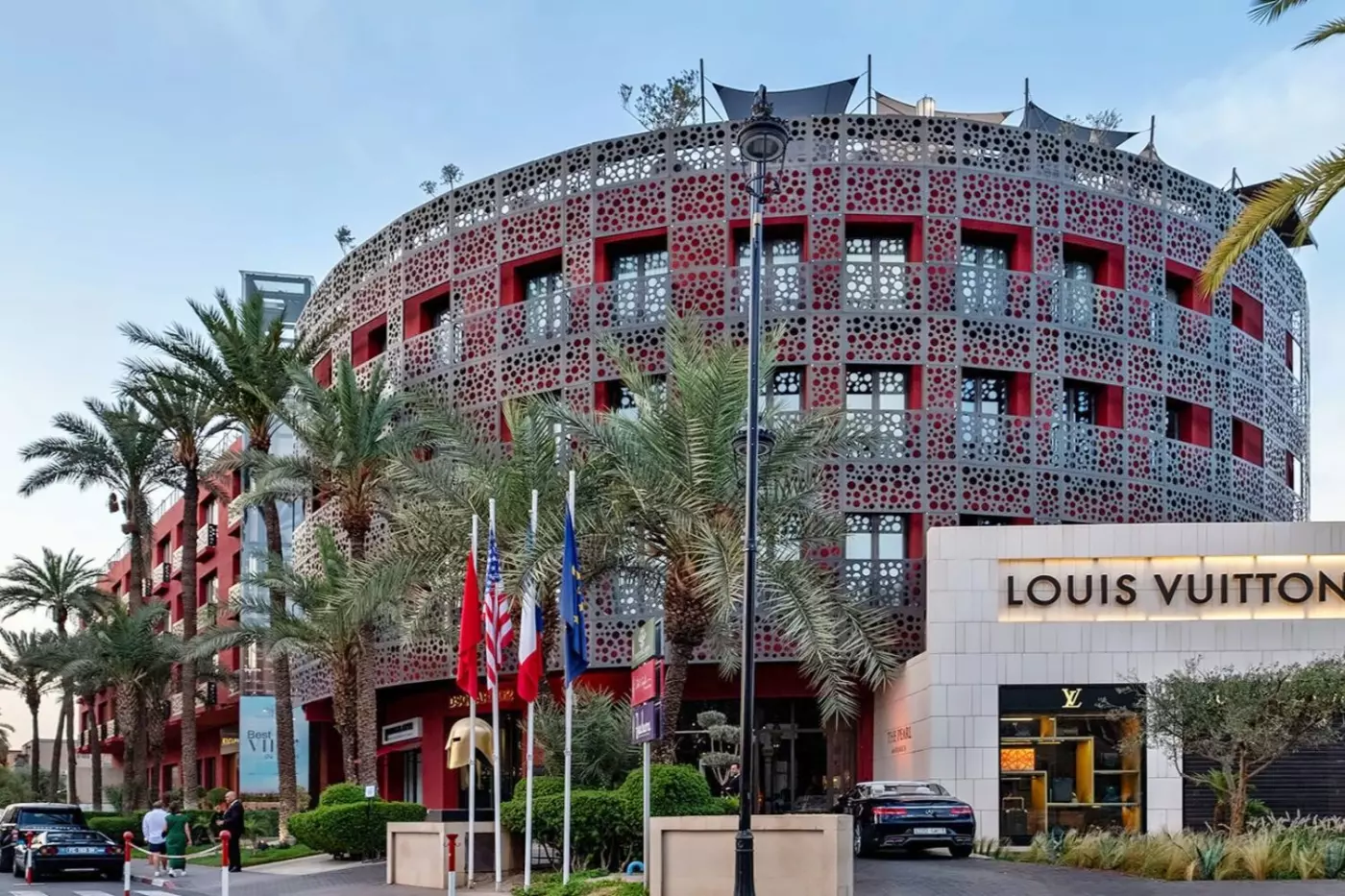
A circular rooftop pool changes the pace of a Marrakech day. At Nobu Hotel Marrakech, guests can return from the medina to a...
More amenities
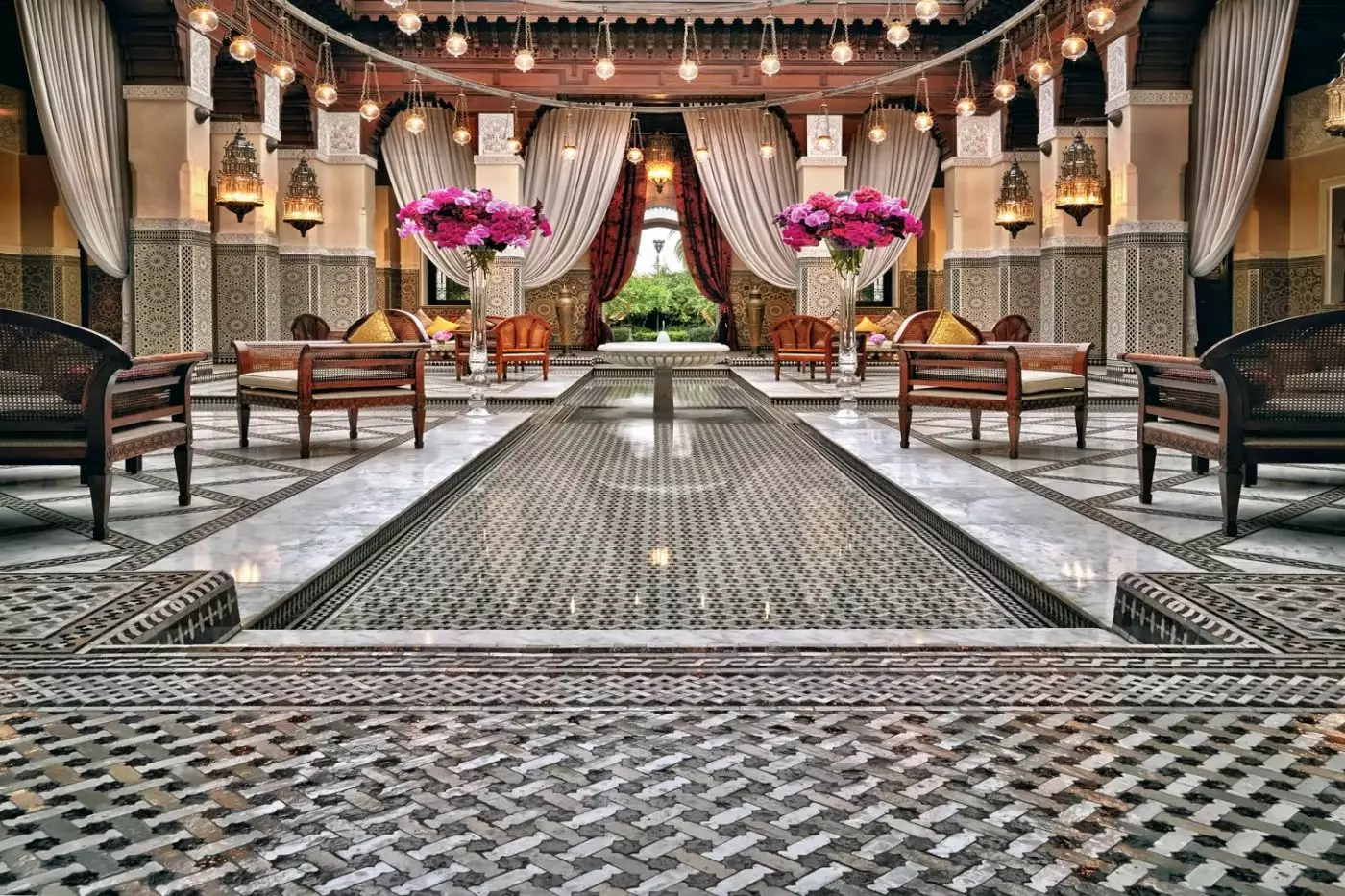
Royal Mansour Marrakech unfolds as a medina of individual riads, winding alleys and gardens within a five-hectare estate. Nea...
More amenities
La Sultana Marrakech is best understood as a Medina hotel with the soul of several historic riads and the facilities of a sma...