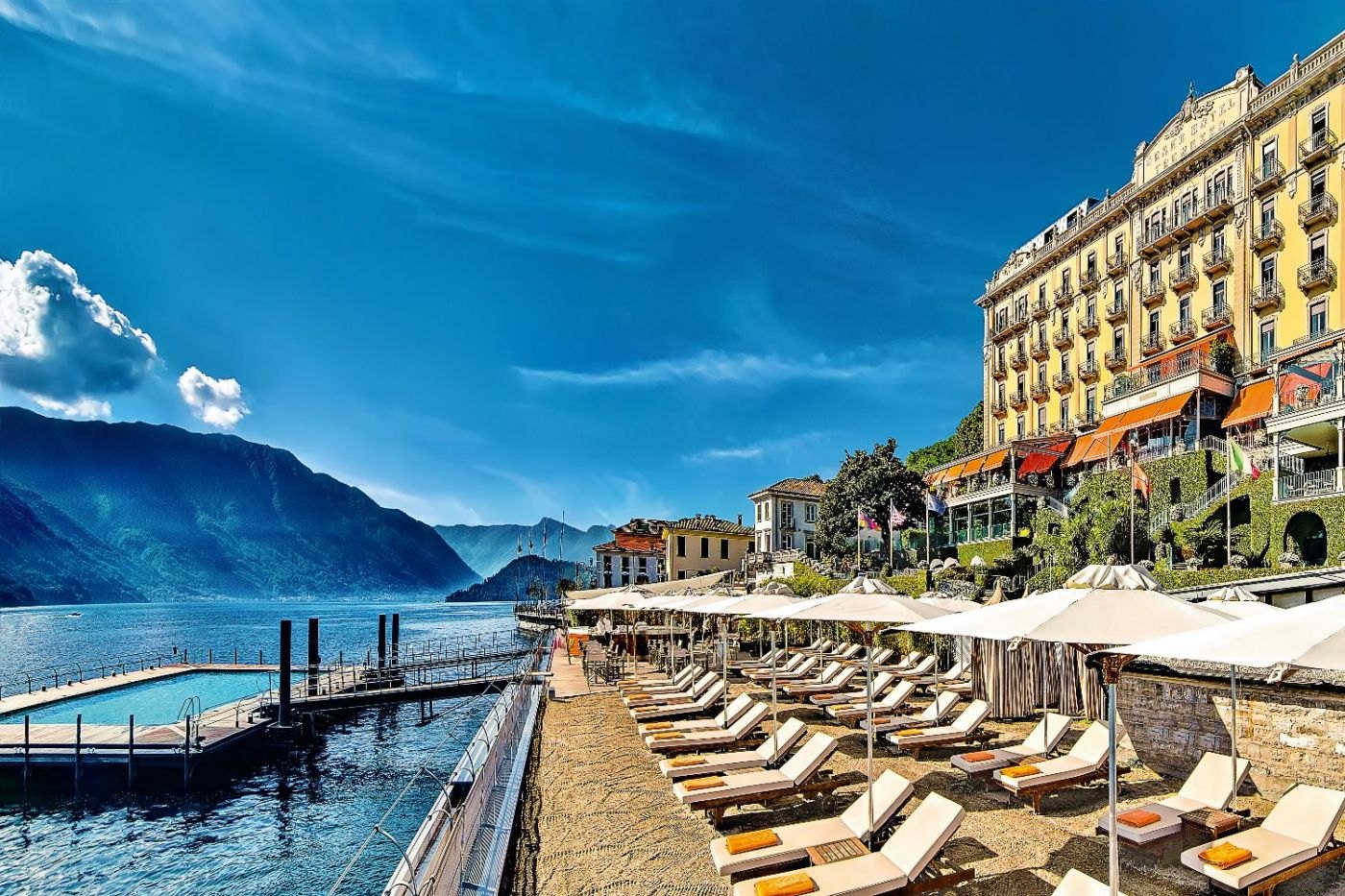
Italy luxury hotel openings 2026 are not a single-city story. The country’s next luxury phase is regional: Rome, Florence, Milan, Lake Como, Venice, and Sicily are all pulling different kinds of high-end traveler.
For PrivateUpgrades travelers, these openings are best understood as signals of where demand, investment, and guest expectations are moving. The point is not to create another list of the best hotels in Italy. It is to understand which regions are gaining new energy and how to plan around them.
Table of Contents
Key Takeaways
- Italy’s luxury wave is regional, not just urban. Rome, Florence, Milan, Lake Como, Venice, and Sicily all serve different high-end travel styles.
- The strongest 2026 story is choice: fashion weekends, art-led city breaks, lake retreats, island resorts, countryside add-ons, and multi-stop luxury trips.
- Concrete names matter: watch The Lake Como EDITION, La Reserve Firenze, Six Senses Milan, Rosewood Milan, Rosewood Rome, Airelles Palladio Venezia, Orient Express Palazzo Dona Giovannelli, Danieli, A Four Seasons Hotel, and Il San Corrado di Noto.
- New openings matter even when travelers book established icons, because they raise expectations around rooms, wellness, service style, dining, privacy, and design.
- PrivateUpgrades benefits are especially valuable in Italy’s high-demand cities and seasonal resorts, where room category and timing can materially change the stay.
The Hotel Openings Driving Italy’s Luxury Shift
Several 2026 hotel openings, announced arrivals, and major reopenings make the shift tangible across the country.
- Lake Como: The Lake Como EDITION gives Cadenabbia a contemporary lake-resort anchor.
- Florence: La Reserve Firenze is planned for 2026 on Via Santo Spirito, while Villa San Michele, A Belmond Hotel has returned after a major restoration above the city.
- Milan: Six Senses Milan in Brera and Rosewood Milan add momentum to a city already shaped by fashion, design, wellness, and short-stay luxury.
- Venice: Airelles Palladio Venezia, Orient Express Palazzo Dona Giovannelli, and Danieli, A Four Seasons Hotel reinforce Venice as one of Europe’s strongest luxury hotel stories.
- Sicily: Il San Corrado di Noto adds weight to south-eastern Sicily as a luxury destination beyond the more established Taormina route.
Why Do Italy Luxury Hotel Openings 2026 Matter?
The phrase Italy luxury hotel openings 2026 can sound like a development headline. In reality, openings show where luxury demand is moving. Travelers still want Rome, Florence, Milan, Venice, Lake Como, and Sicily, but they increasingly expect stronger wellness, more residential suites, restaurants with local relevance, historic hotels that feel contemporary, and more privacy and sense of place.
The important signal is not that one hotel will change Italy. It is that several regions are evolving at the same time. That is why this is a planning guide around the next layer of Italian luxury, not a generic hotel ranking.
Concrete Italy Hotel Openings To Watch In 2026
The 2026 Italy hotel pipeline is especially useful because it shows where new luxury demand is concentrating, not only which brands are opening doors.
For searchers comparing the 2026 Italy hotel pipeline, concrete names matter. The table below separates openings, announced arrivals, and major reopenings from the broader regional story, and flags why each hotel changes the luxury-travel map.
The Italy Luxury Opening Map 2026
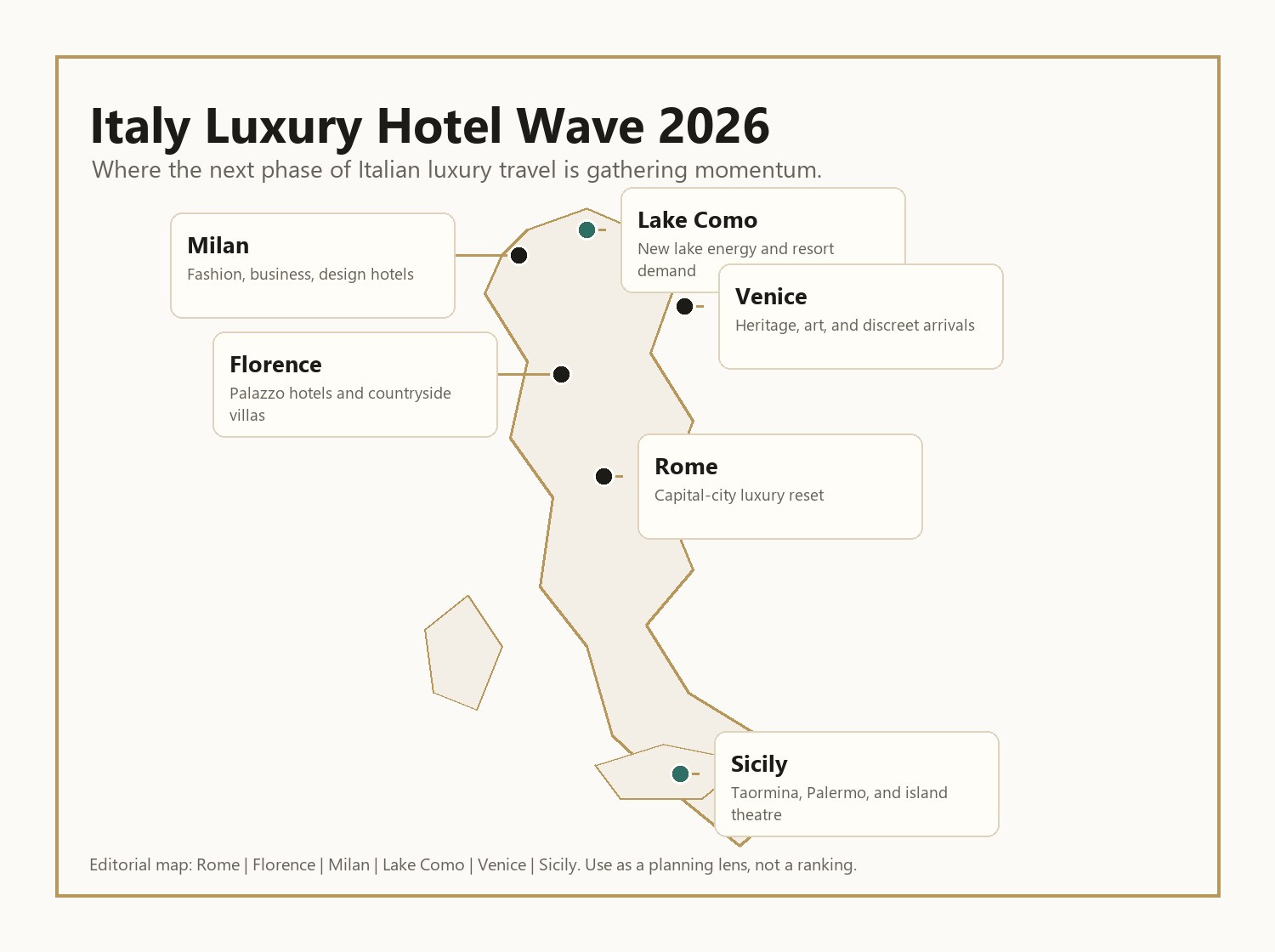
The map below is an editorial lens, not a ranking. It shows the main places where luxury travelers should pay attention now: Rome, Florence, Milan, Lake Como, Venice, and Sicily. Each has a different travel logic.
Key Takeaways
- Italy’s luxury wave is regional, not just urban. Rome, Florence, Milan, Lake Como, Venice, and Sicily are pulling different types of high-end traveler.
- The strongest 2026 story is choice. Italy now works for fashion weekends, art-led city breaks, lake retreats, island resorts, countryside add-ons, and multi-stop luxury trips.
- The wave is backed by real hotel names. Watch The Lake Como EDITION, La Reserve Firenze, Villa San Michele, Six Senses Milan, Airelles Palladio Venezia, Orient Express Palazzo Dona Giovannelli, Danieli, A Four Seasons Hotel, and Il San Corrado di Noto.
- New openings matter even when you book established icons. They raise expectations around rooms, wellness, service style, dining, privacy, and design.
- Lake Como and Sicily are no longer side notes. They increasingly serve as primary luxury anchors, not only post-Rome or post-Florence extensions.
- PrivateUpgrades benefits matter in Italy. Breakfast, hotel credits, upgrades, early check-in, late check-out, and VIP recognition can be especially valuable in high-demand cities and seasonal resorts.
Why Italy Luxury Hotel Openings 2026 Matter
The phrase Italy luxury hotel openings 2026 can sound like a development headline. It is more useful than that. Openings tell you where hotel groups believe demand is becoming more sophisticated. In Italy, the pattern is clear: travelers still want Rome, Florence, Milan, Venice, Lake Como, and Sicily, but they want those places to behave differently.
They want city hotels with stronger wellness and better suites. They want old buildings that do not feel dusty. They want restaurants that matter to locals, not only hotel guests. They want lake hotels that can handle privacy and arrival theatre. They want Sicily to deliver landscape, food, history, and resort comfort without feeling like a compromise.
Travel Weekly’s recent Italy luxury coverage points to this exact momentum, highlighting new luxury attention around Florence, Rome, Sicily, and Milan. The important reading is not that one hotel will change Italy. It is that several regions are being upgraded at the same time.
That is why this is not a list of the best hotels in Italy. It is a planning guide for where the next layer of Italian luxury is gathering force, and how to choose the right region through PrivateUpgrades luxury hotels in Italy.
Concrete Italy Hotel Openings To Watch In 2026
For searchers comparing the 2026 Italy hotel pipeline, the concrete names matter. The table below separates confirmed 2026 openings, announced 2026 arrivals, and major 2026 reopenings from the broader regional story. It also flags why each hotel changes the luxury-travel map, rather than simply adding another address.
| Hotel | Location | Opening timing | Why it matters |
|---|---|---|---|
| The Lake Como EDITION | Cadenabbia, Lake Como | 2026 debut / March 2026 opening cycle | A design-led EDITION arrival in a historic lake address, giving Como a more contemporary alternative to classic grand hotels. |
| La Reserve Firenze | Florence, Via Santo Spirito | Announced for 2026 | A small, private, apartment-style Florentine address that reinforces the city’s palazzo-and-privacy trend. |
| Villa San Michele, A Belmond Hotel | Fiesole, Florence | Reopened for the 2026 season after restoration | Shows how established Italian icons are being renewed with stronger suites, gardens, wellness, and private-villa energy. |
| Six Senses Milan | Brera, Milan | Planned late 2026 | Gives Milan a wellness-led luxury signal, which matters in a city already strong in fashion, design, and business travel. |
| Airelles Palladio Venezia | Giudecca, Venice | Spring 2026 opening | A heritage retreat with gardens, spa, pools, and a more private Giudecca rhythm away from the busiest parts of Venice. |
| Orient Express Palazzo Dona Giovannelli | Cannaregio, Venice | Spring 2026 opening | A restored 15th-century palazzo that turns Venice into one of Italy’s clearest 2026 hotel-opening markets. |
| Danieli, A Four Seasons Hotel | Venice, near Piazza San Marco | Expected August 2026 reopening | A landmark reopening that shows how established icons are being repositioned for the next luxury cycle. |
| Il San Corrado di Noto | Noto, Sicily | 2026 reopening / relaunch cycle | Adds a concrete Sicily opening angle beyond Taormina, reinforcing the island’s shift toward longer, more serious luxury stays. |
Editorial note: hotel-opening dates can move. The timing above reflects announced or reported 2026 opening windows at the time of writing and should be confirmed before planning a trip around a specific property.
The Italy Luxury Opening Map 2026
Rome: The Capital Luxury Reset
Rome luxury hotels are entering a more competitive phase. The city has always had grand addresses, but the current wave is sharper. New and refreshed hotels have pushed the market toward stronger design, better wellness, more residential suites, and a more international level of service.
Rome is also the most useful city for travelers who want cultural depth without giving up hotel comfort. A good Roman stay is not only Colosseum, Vatican, and dinner. It is a morning with a private guide, a slow lunch in a neighborhood that still feels lived-in, a pause in a courtyard, and an evening where the hotel becomes a calm return rather than just a bed.
For PrivateUpgrades travelers, Rome works best when the hotel sits inside the rhythm of the itinerary. Hotel de Russie is a strong example for travelers who want garden privacy and central access. Bulgari Hotel Roma suits a more contemporary Roman mood, where design, dining, and brand theatre matter. The planned 2026 arrival of Rosewood Rome adds another named reason to watch the capital’s next phase.
Explore Rome Luxury Hotels With VIP Benefits
Florence: Palazzo Hotels, Gardens, And The Tuscan Extension
Florence is not trying to become Rome. Its luxury appeal is more delicate. The city works when the hotel gives you breathing room between museums, private shopping, river walks, and dinners that stretch late without needing to become theatrical.
The new Florence energy is partly about restored palazzo addresses and partly about the villa layer outside the historic center. That is important because many luxury travelers no longer want a purely urban Florence stay. They want the Uffizi and artisan workshops, but also gardens, terraces, Tuscan dinners, and mornings that do not feel rushed. La Reserve Firenze, planned for summer 2026, points to the same desire for privacy, residential scale, and high-touch service inside the historic city.
Florence luxury hotels on PrivateUpgrades already show that split. Portrait Firenze is strong for travelers who want the Arno, fashion-world polish, and a very central stay. Four Seasons Hotel Firenze gives Florence a resort-like garden dimension, which is increasingly relevant as the city gets busier.
Explore Florence Luxury Hotels With VIP Benefits
Milan: Design, Fashion, Business, And Short-Stay Precision
Milan’s role in the Italian luxury wave is different. It is less romantic on the surface and more useful. That is precisely why it matters. Milan is where fashion, design, fairs, private shopping, business travel, and short luxury weekends can work with unusual efficiency.
The city is also becoming more interesting for travelers who do not want Italy to feel nostalgic. A Milan stay can be about contemporary interiors, sharp service, aperitivo culture, galleries, and a hotel that understands schedule pressure. It is Italy, but with a more edited line. Six Senses Milan, planned for late 2026 in Brera, and Rosewood Milan, slated for 2026, make that shift more concrete.
Milan luxury hotels are especially relevant when the trip is built around shopping, Salone del Mobile, fashion week, business meetings, or a fast pre-lake stop. Portrait Milano brings a more residential, fashion-led mood. Mandarin Oriental Milan fits travelers who want spa, dining, and central access without losing calm.
Explore Milan Luxury Hotels With VIP Benefits
Lake Como: The New Lake Cycle
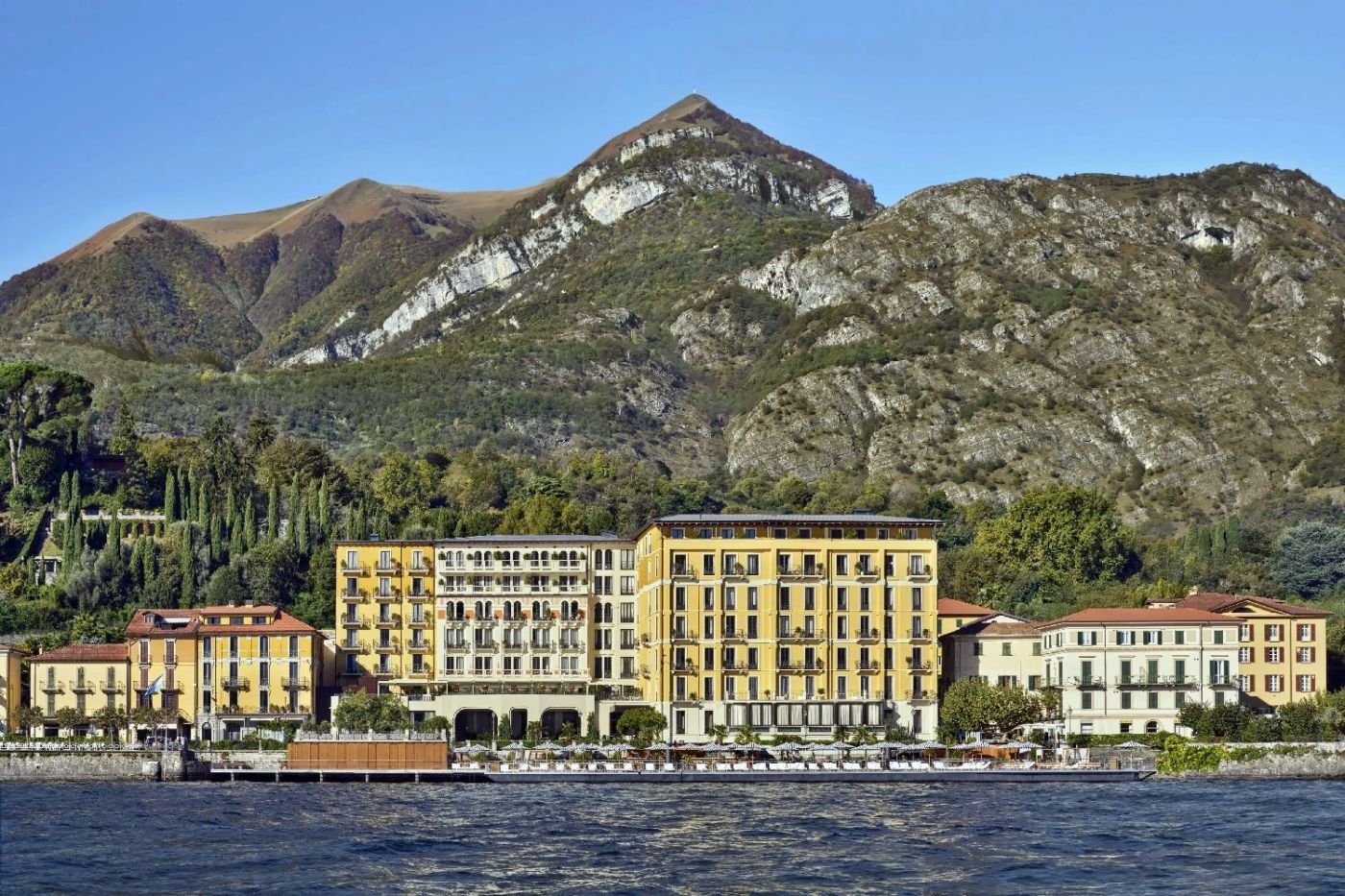
Lake Como has always had glamour, but the current wave gives it a different edge. The lake is no longer just a beautiful extension after Milan or Venice. It is increasingly a primary luxury destination with its own design language, arrival rituals, boat days, pool scenes, and high-demand room categories.
The opening and visibility of properties such as The Lake Como EDITION signal why the lake keeps moving. Travelers want the cinematic landscape, but they also want contemporary rooms, strong food and beverage, privacy, and the confidence that the hotel can manage complex arrivals and high expectations.
Como luxury hotels and Tremezzo luxury hotels on PrivateUpgrades show the range. Grand Hotel Tremezzo remains a classic lake theatre address. The newer generation points toward a less formal, more design-aware version of lake luxury.
Explore Lake Como Luxury Hotels With VIP Benefits
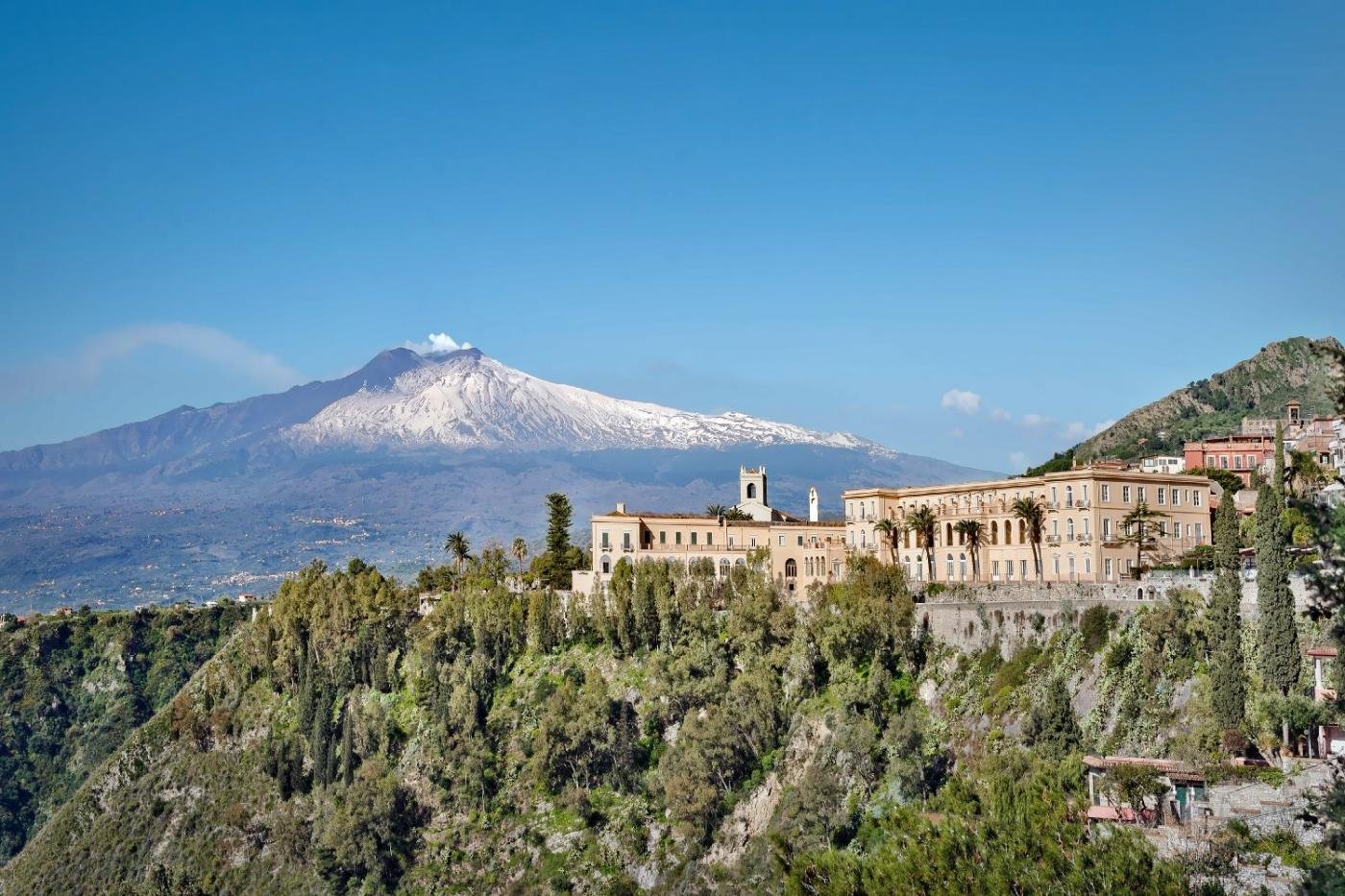
Sicily: Island Drama Becomes Serious Luxury
Sicily is perhaps the most emotionally powerful part of the wave. It is not as frictionless as Milan or as instantly legible as Florence, but that is also its strength. Sicily has Greek theatres, Etna, Palermo palaces, beaches, fishing towns, vineyards, heat, theatre, and a sense of place that does not feel manufactured.
For a luxury traveler, Sicily now works in two main ways. Taormina gives the grand, cinematic version: sea views, terrace breakfasts, resort pacing, and a hotel scene that can feel like a stage. Palermo offers a more urban, aristocratic version, with history, palaces, markets, and a less polished but more textured rhythm.
Taormina luxury hotels include San Domenico Palace, Taormina, A Four Seasons Hotel and Grand Hotel Timeo, A Belmond Hotel. In Palermo, Villa Igiea gives the city a serious luxury anchor. This is where Italy feels less like a museum and more like a living stage.
Explore Sicily Luxury Hotels With VIP Benefits
Venice: Heritage Luxury Under Pressure
Venice is not the newest part of the story, but it remains essential. In a period when Italy is seeing more luxury attention elsewhere, Venice shows why established heritage destinations need careful hotel selection. The city can be magical, but it can also be crowded, expensive, and logistically awkward if the stay is planned badly.
This is where the right hotel does real work. Private arrival, water access, room view, concierge timing, breakfast setting, and retreat value matter more than in many cities. Venice rewards travelers who build in quiet and avoid treating the hotel as an afterthought.
Venice luxury hotels such as Aman Venice show the appeal of controlled heritage: a grand setting, privacy, and enough separation from the city’s daily pressure. Venice is also a real 2026 opening story: Airelles Palladio Venezia has opened on Giudecca, Orient Express Palazzo Dona Giovannelli brings the Orient Express hotel world into Cannaregio, and Danieli, A Four Seasons Hotel is expected to reopen in August 2026.
Explore Venice Luxury Hotels With VIP Benefits
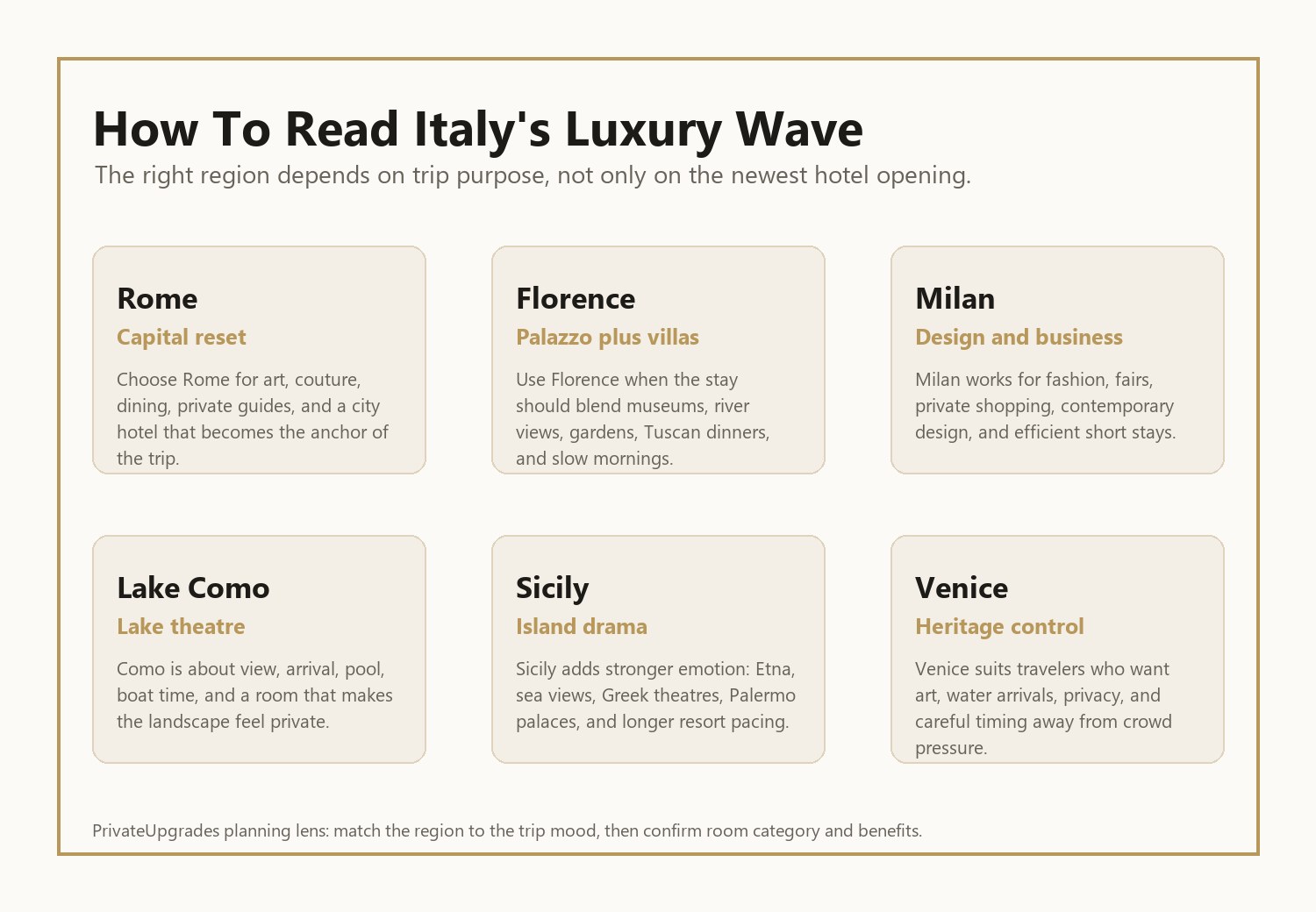
How To Choose The Right Italy Region In 2026
If You Want Culture And Couture
Start with Rome. It has the strongest mix of ancient sites, private guiding, shopping, restaurants, and capital-city hotel energy.
If You Want Art And Gardens
Choose Florence. It works best when the stay balances museums, river views, gardens, villas, and slower Tuscan pacing.
If You Want Design And Efficiency
Use Milan. It is the cleanest choice for fashion, design, business, private shopping, and short high-end stays.
If You Want Arrival Theatre
Look at Lake Como and Tremezzo. The hotel view, boat day, terrace, and pool scene are the core experience.
If You Want Emotion And Landscape
Choose Taormina or Palermo. Sicily is strongest when the trip has enough nights for heat, history, food, and sea views.
If You Want Heritage Control
Choose Venice. It requires careful timing, but the right hotel makes the city feel private again.
What Not To Do With Italy’s Luxury Wave
The mistake is trying to collect regions like trophies. Rome, Florence, Milan, Lake Como, Venice, and Sicily can all be excellent, but not in one rushed trip. Italy punishes overpacking. Transfers are part of the experience only when they are designed with enough space.
For a first luxury Italy trip, choose one city and one slower extension. Rome plus Sicily works. Milan plus Lake Como works. Florence plus Tuscan countryside works. Venice plus Lake Como can work if the travel rhythm is gentle. Rome, Florence, Milan, Venice, Lake Como, and Sicily in one run is usually itinerary noise.
The other mistake is booking too late for the room category that defines the stay. In Italy, view, terrace, garden access, canal position, lake frontage, suite layout, and arrival logistics can be more important than the hotel name alone.
Why PrivateUpgrades Benefits Matter In Italy
PrivateUpgrades benefits matter in Italy because many stays are detail-sensitive. Breakfast can be a major part of the day. Hotel credits can support a long lunch, spa treatment, or bar moment. Upgrade opportunities matter because views and suite categories can change the whole stay. Early check-in and late check-out are useful when international flights, train transfers, or boat arrivals do not match standard hotel timing.
Benefits do not replace good planning. They add a second layer of value once the right region and hotel have been chosen. That distinction is important. Italy is not a place where a benefit can fix the wrong base. But at the right hotel, benefits can make the stay feel more considered and less transactional.
Explore Hotel Promotions In Italy On PrivateUpgrades
FAQ: Italy Luxury Hotel Openings 2026
Why are Italy luxury hotel openings in 2026 important?
They show that investment is spreading across several Italian regions, not only one city. For travelers, that means more choice across city, lake, island, and countryside-style stays.
Which Italian regions are most relevant for luxury travel now?
Rome, Florence, Milan, Lake Como, Venice, and Sicily are the main regions to watch. Each serves a different travel purpose, from cultural depth to fashion, lake scenery, heritage privacy, and island resort pacing.
Which 2026 Italy hotel openings should I know by name?
Key 2026 names include The Lake Como EDITION in Cadenabbia, La Reserve Firenze in Florence, Six Senses Milan in Brera, Rosewood Milan, Rosewood Rome, Airelles Palladio Venezia, Orient Express Palazzo Dona Giovannelli, and Danieli, A Four Seasons Hotel in Venice.
Is this article a list of the best hotels in Italy?
No. It is a planning guide around the current Italian luxury hotel wave. The goal is to explain where luxury demand is moving and how to choose the right region and hotel style.
Should I book a new hotel or an established Italian icon?
Both can make sense. New hotels can bring fresher design and service ideas, while established icons often have stronger location, heritage, and operating confidence. The better choice depends on the trip purpose.
Can I book Italian luxury hotels with PrivateUpgrades benefits?
Yes, many Italy hotels on PrivateUpgrades can include benefits such as breakfast, credits, upgrade opportunities, early check-in, late check-out, and VIP recognition where available.
Methodology
This guide uses current luxury travel and hospitality reporting, confirmed PrivateUpgrades destination and hotel availability, and editorial assessment of how high-end travelers use Italy. It focuses on the places where new-opening momentum, established luxury depth, and practical itinerary value overlap.
Plan An Italy Luxury Trip With PrivateUpgrades
The strongest Italian trips in 2026 will not be the ones with the most hotel names. They will be the ones with the clearest rhythm: Rome for culture, Florence for art and gardens, Milan for design, Lake Como for lake theatre, Venice for controlled heritage, or Sicily for emotion and landscape.
Use PrivateUpgrades to compare luxury hotels in Italy, check available VIP benefits, review promotions, and choose the region that fits the trip rather than the itinerary that tries to do everything.